
Spend even a day wandering Madrid and you start to notice its pattern. The city moves between extremes: vast, sun-drenched plazas that seem to hold half the sky, and then sudden dark, quiet, centuries-old hidden corners. I hadn’t quite understood this flow of the city until I was standing in the corridor of The Palace, admiring a carpet with animals hidden in its design and a painting of a deer that, from one angle, was perfectly lovely — and from the other, something altogether more modern and industrial. It was the moment it clicked. The Palace was designed with the city as its blueprint. It’s Madrid in miniature, and that is the highest compliment.
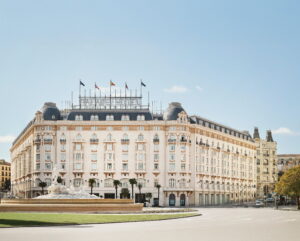
Commissioned by King Alfonso XIII and opened in 1912, The Palace has spent over a century as a regular haunt for some remarkable guests: Dalí, Picasso, Einstein and García Márquez have all passed through, and the hotel carries that history naturally. Having joined The Luxury Collection last year following a landmark €90 million restoration, led by architectural firm Ruiz Larrea and interior designer Lázaro Rosa-Violán, it has returned to something close to its original glory. For planners, the numbers stack up convincingly: 21 dedicated event spaces across 2,500 square metres, alongside 470 fully renovated guestrooms and suites. Dedicated event coordinators, flexible configurations, complimentary suite upgrades, and spaces that combine or divide for anything from a 10-person leadership session to a gala dinner for hundreds.
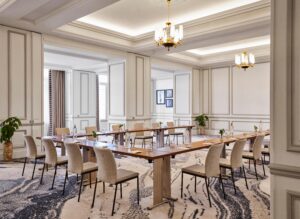
The meeting rooms deserve a mention of their own, because here is the detail that will stay with me: they do not remotely look like meeting rooms. Warm, full of character and perfectly in keeping with the rest of the hotel. The Neptuno Room is the centrepiece: a sweeping ballroom with direct views of the fountain below, capacity for up to 285 guests, divisible via movable panels, and expandable by connecting with the Cánovas and Cervantes Rooms. The Hemingway Room is the intimate counterpart: quiet, refined, and carrying a name that does considerable work before the meeting has even started. Espacio Palace, the most contemporary offering, is fully equipped and adaptable with direct street access for external delegates. The spaces are flooded with natural daylight, with full AV and high-speed wireless throughout.
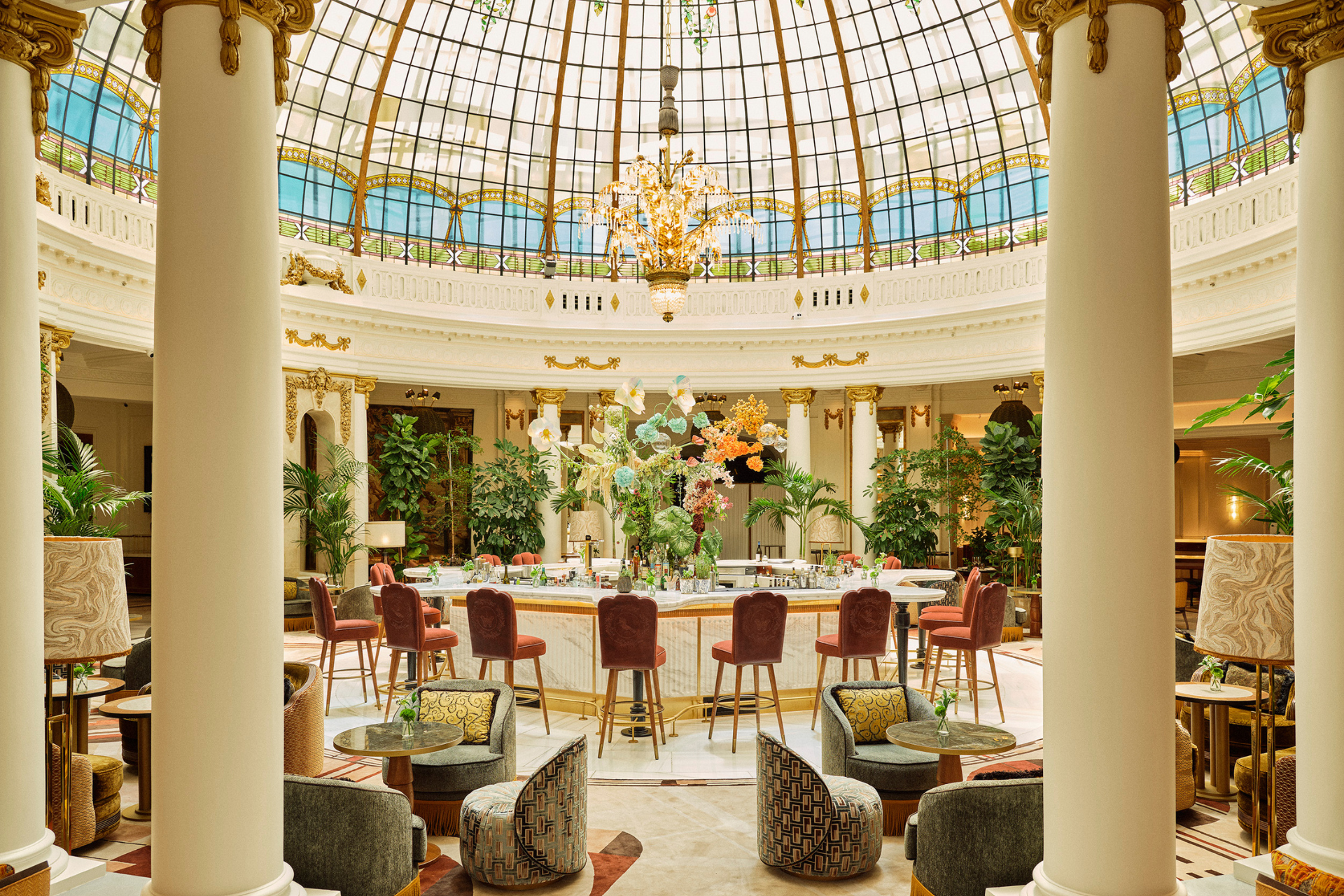
I was taken around the hotel by Paloma Garcia, director of marketing and communications, who has spent virtually her entire career here, and it showed in every conversation. Lunch was in La Cúpula Restaurant & Bar, the undisputable heart of the hotel, beneath the extraordinary stained-glass dome, 1,875 hand-decorated glass panes crafted by Maison Maumejean. The room is simply breathtaking: vast, light-filled and serene all at once. We ate well, working through a spread of traditional Spanish dishes — the jamón alone would be worth returning for. Each evening, in-house guests are treated to a daily Epicurean Moment: a complimentary signature cocktail and traditional tapas. Ours was an iced vermouth paired with a gilda, an anchovy, olive and pickled pepper skewer that is somehow both deeply salty and faintly sweet. It would be my first of the trip, but most certainly not my last.
The guestrooms are spectacular, each one individually designed and hand-painted with wallpaper inspired by El Retiro Park, Madrid’s Royal Botanical Garden. Mine overlooked the Fuente de Neptuno, the fountain on the plaza below, and despite this, not a whisper of traffic noise reached me. Bright, serene and spacious, with a large bath and generous shower, and those trees I kept noticing on every wall. The kind of room you keep finding reasons to come back to.
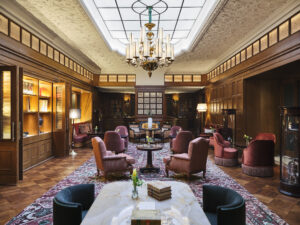
The discovery that rounded off the stay was the sleek and oh-so suave 27 Club, tucked just off La Cúpula. Named for the literary Generation of ’27, whose members including García Lorca, Dalí and Buñuel were regulars, it retains its original wood panelling, protected by the Heritage Commission, and walls lined with 70 bespoke illustrations drawn from the hotel’s own archives. The cocktail menu leans into this history with genuine wit: Pre-Prohibition and Prohibition era classics alongside signatures like the 1912 John Collins and Un Americano en el Prado. Cosy, velvet-plush and low-lit, it feels like a rich gentleman’s private library that has been kept exactly as he left it. It is also, famously, the bar that earned Ernest Hemingway’s written praise. He stayed here and wove it into his novel: The Sun Also Rises. Sipping a dry martini in the exact same spot, I couldn’t help feeling this may be an obvious starting point for anyone hoping to write like Hemingway. The jury is still out on the effects of that experiment — but at the very least, it was an exceptional martini.
The Palace is not merely a conference hotel with good bones. It is a place with a philosophy, borrowed from the city it lives in, visible in every transition from bright to hushed, from grand to intimate, from the lobby to the meeting room to the bar. For incentive travel, it is close to a perfect brief. For conferences and corporate events, the scale, service and setting are simply hard to beat in the Spanish capital. For any planner tired of venues that look like every other venue: the meeting rooms here, genuinely, don’t feel like meeting rooms. In 2026, that might be the most exciting thing you can say.