
At How to Copenhagen 2025, Adam Kuskner, a social behavioural specialist at the Centre for a Plant Based and Organic Future, which promotes organic and plant-based food from farm to fork made a compelling case that the key to greener events isn’t telling guests what not to eat — it’s redesigning the choices in front of them.
If you ask anyone to recall an event they attended six months ago, they will most likely mention the food — which makes it such a powerful tool for creating more sustainable events. It was this insight that Kuskner brought forward to a group of event professionals in Copenhagen. His message was clear, and perhaps a little counterintuitive: if you want guests at your events to eat less meat, don’t tell them to eat less meat.
The events industry is aware that it needs to act on food emissions. Red meat produces roughly 75 kilos of CO₂ equivalents per kilogram, accounting for water use, land, transportation and feed production, compared to a mere fraction of that for plant-based alternatives. Denmark, where the Centre for a Plant Based and Organic Future operates, has even introduced the world’s first national action plan for plant-based foods. Its safe to say that the science is not in dispute, but knowing something is bad for the planet and choosing to act on that knowledge are two very different things.
“Living sustainably is not easy,” Kuskner acknowledged to the room. “We all have the ambition, but sometimes we need a little push in the right direction.”
That push has a name in behavioural science: nudging. Defined formally as adapting the decision-making environment to influence behaviour, the concept is rooted in the understanding that humans rarely make food choices through careful, rational deliberation, with ingrained habits, physical environment, and social cues doing most of the work instead. The event planner’s role, Kuskner argued, is not to educate or persuade. It is to design the environment so that the sustainable choice becomes the easy, natural, and socially normal one. “You are architects of choices,” he said. “No design is neutral.”
Four tools you can use right away
Drawing on trials conducted with Danish hotels, conference centres and venues, Kuskner offered a practical toolkit of tested interventions that have produced significant results.
1. Change the language
The words on your menu matter more than you think. In one well-known Danish retail example, a product called “veggie lasagne” was relaunched as “spinach and ricotta lasagne.” Sales rose by 200%, not because the product changed, but because the new name evoked flavour and texture rather than a dietary guideline. “Veggie” signals to the non-vegetarian that this is a lesser version of the real thing, whereas “spinach and ricotta” sounds delicious.
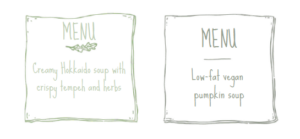
The principle translates directly to event catering. “Cuban Black Bean Stew” is a dish; whereas “low-fat vegan bean soup” sounds much less appetising. The rule is simple: describe food using sensory and cultural language, such as slow-roasted, Asian-inspired, caramelised, spiced, and avoid labels like vegan, climate-friendly or low-calorie. “I don’t know the taste of climate-friendly,” Kuskner joked. “I’ve never tasted it.”
2. Position is key
Menu design and buffet layout have a powerful, and mostly unconscious influence on what guests put on their plate. Place your best plant-based or plant-rich dish at the top of the menu, and lead the buffet with vegetables and grains before guests reach the protein. One kitchen manager at a major Copenhagen conference venue reported a 50% reduction in charcuterie consumption simply by moving it to the end of the buffet line. On menus, having more plant-based options than meat-based ones shifts perception: guests read a meat-heavy menu as a signal that the kitchen knows how to cook meat, and the lone vegetarian dish is just an afterthought. Flip the ratio and that assumption flips with it.
3. Use meat as an add-on
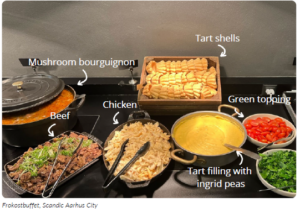
In one of his most striking trial results, Kuskner described a buffet redesign in which meat was removed from the main dishes and offered as a side topping instead, placed next to a mushroom-based dish. 99% of guests still took some meat, but the total amount served was reduced to one third of the usual quantity. No one complained and no one felt anything had been taken away. “If you say we are removing the meat, people will be angry, but here they made the decision themselves,” said Kuskner.
4. The default option
The most powerful nudge of all requires the least effort from delegates, which is precisely why it works so well. Rather than asking vegetarians to flag their dietary requirements in advance, Kuskner proposed flipping the default: inform delegates that the event will serve a plant-based menu as standard, and invite those who would prefer a non-plant-based option to let the organisers know. A study at a Danish university demonstrated the results clearly: when the standard menu was non-vegetarian, 94% of delegates stuck with it and just 6% requested something plant-based. When the plant-based option became the default, 87% kept it and only 13% opted out.
The psychology at play is quite straightforward: We trust authority. We defer to a decision already made. We assume the chefs know what they’re doing. Also, as Kuskner found when speaking to delegates, many people feel quite comfortable eating plant-based food at a conference even if it’s not how they normally eat at home.
Flexitarians are the audience
The events industry has tended to think of sustainable food as a niche concern, something you accommodate for the small percentage of vegetarians and vegans in any given room. Kuskner challenges by suggesting that the real target group is the flexitarian majority: people who eat meat but not exclusively, who are open to trying something different, who want a good experience and will respond to a well-designed one.
“We don’t try to convince people who love meat to stop eating meat,” he said. “We just try to normalise plant-rich food.” That is a much more manageable issue and, as the trial results suggest, a highly tractable one. The opportunity for event planners is significant. With the right menu language and the right buffet layout you can meaningfully reduce the carbon footprint of your events without a single delegate feeling they’ve made a sacrifice. They’ll just remember that lunch was delicious.