
Are events delivering real impact – or just more content? Leslie Robertson, founder of OpenAudience, explores why outcomes, not agendas, should define success…
Most events don’t suffer from a lack of content. If anything, they have too much of it.
More speakers. More slides. More sessions. All carefully planned, professionally delivered, and usually well received in the room.
And yet…
A few weeks later, it’s hard to point to what actually changed.
And that’s a problem, because change is usually the reason the event existed in the first place.
It’s something that comes up more often than people admit.
Particularly in conversations around how events are expected to deliver more than just a good experience.
Because success is still often measured by what happens during the event. Did it run smoothly? Were people engaged? Did stakeholders feel it was worthwhile?
But that’s not what organisations are really investing in events for.
They’re investing to align teams, shift thinking, support decisions, and drive action.
And that’s where things start to break down.
Because if the outcome isn’t clear, it becomes very hard to justify the investment.
Adding more content doesn’t solve that problem. In fact, it often makes it worse.
Because within any audience, you’re rarely starting from the same place.
Some people have heard it all before. Others are hearing it for the first time.
Some are ready to act. Others are still trying to make sense of what it means.
So, the more content you add, the more likely you are to lose part of the room either way.
The events that do land differently make a subtle shift.
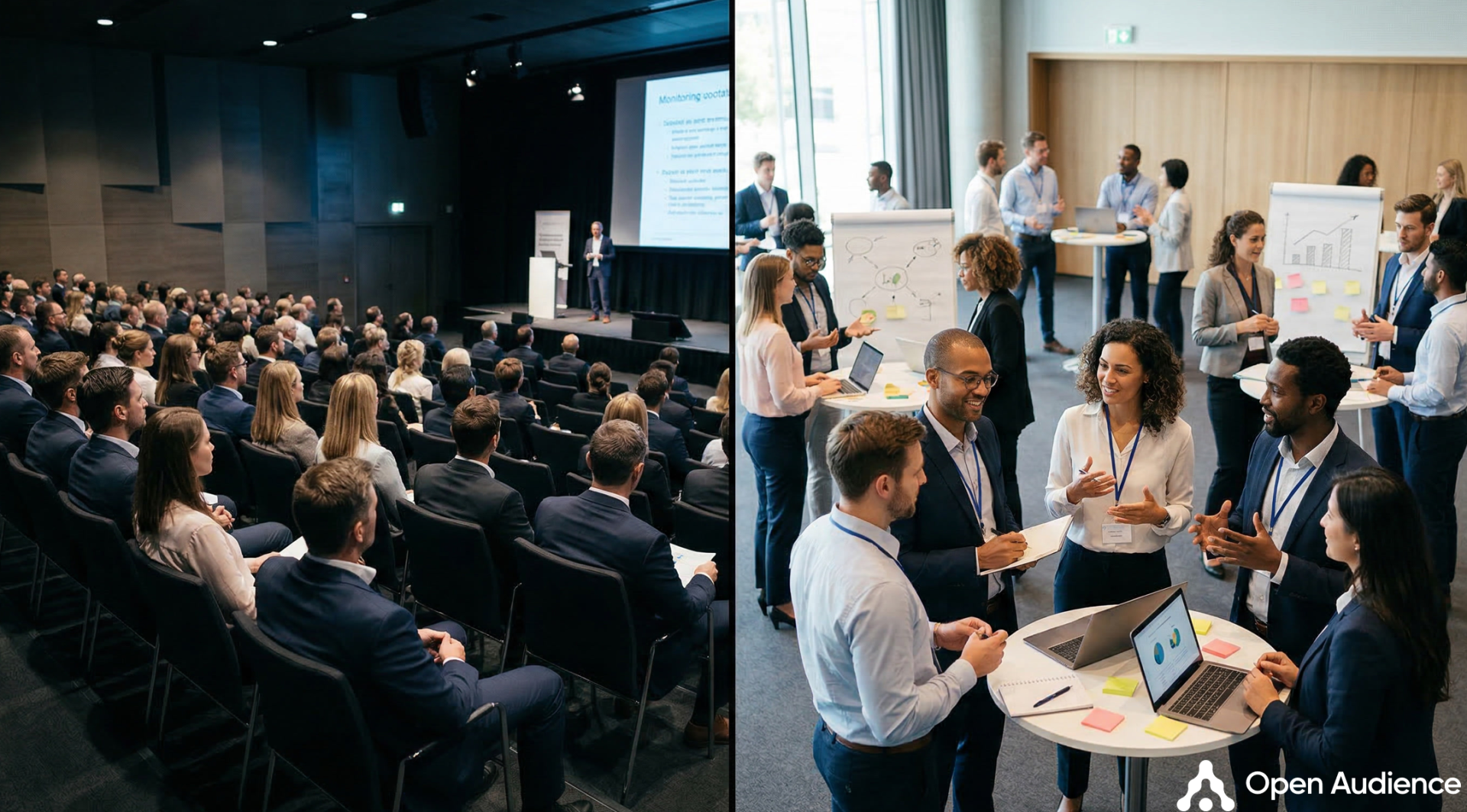
They don’t just focus on what’s being presented. They focus on how people are thinking, responding, and contributing in the moment.
They create space for people to test ideas, challenge assumptions, see how others are interpreting the same information, and start forming their own point of view.
Not as an add-on at the end, but as part of the design.
Because ultimately, if nothing changes after an event…
It’s just expensive content.
This isn’t about making events more interactive for the sake of it.
It’s about recognising that the real value of bringing people together isn’t just what they hear.
It’s what they do with it.
And that only happens when events are designed not just to deliver information, but to shape conversations that lead somewhere.
Because the difference between a well-run event and a valuable one isn’t always visible in the moment…
It shows up in what people do differently afterwards.
And increasingly, that’s the difference organisations are starting to pay attention to.
Leslie Robertson is Founder of OpenAudience, working with organisations and agencies to design events that drive alignment, decision-making, and measurable outcomes.