
By Mark Hutchinson, Managing Director, INCEPTION
Let’s be honest about the state of global B2B exhibitions: the traditional “cost-per-square-metre” budget model is fundamentally broken. It forces brands to spend their money on 2D graphics and modular walls, while treating the one thing that actually drives ROI, premium brand experiences and hospitality, as an afterthought.
The problem is that the traditional B2B events industry is driven by a highly transactional mindset, a standard that naturally facilitates this mistake. We’ve all sat in the same briefings. A CMO is flying a 20-person sales team to Money20/20 or Web Summit to drive lead gen. With Forrester’s latest 2026 research showing that many B2B sectors now allocate over 30% of their program budgets to live events, it is usually the largest single line item that a marketing director manages. So, they outline a strict £100,000 cap for the physical build, and every single penny is scrutinised.
But the second you suggest adding a high-end barista station or a cocktail lounge to actually attract Tier 1 prospects, the purse strings magically loosen. Suddenly, someone “finds” another £10,000+.
Marketers are absolutely right to value hospitality this highly. But they are applying the logic backwards. The trap is treating hospitality as a last-minute £10k+ accessory bolted onto a traditional build, rather than the foundational core that dictates the architecture from day one.
The “Soho House” Standard vs. The Carpeted Aisle
The reality of modern trade shows is that your C-level delegates expect an experience that matches their lifestyle.
The decision-makers walking the floor at Sibos or DMEXCO flew business class to get there. They are staying in five-star properties. But when you finally manage to draw them off the concourse into your space, what do you offer them? A lukewarm filter coffee in a paper cup, while your sales rep awkwardly pitches a £250,000+ enterprise software contract over the deafening noise of the PA system.
It is a disconnect that immediately devalues the brand. The fact is, you’re competing with Soho House, the Virgin Atlantic Clubhouse, and luxury hotel lobbies, not just the booth across from you. You really don’t want your target prospects leaving your space to have their actual business conversations over a meticulously sourced flat white in the venue lobby. If they are, that £100,000 build was a waste of money.
Stop Building Showrooms. Start Building Members’ Clubs.
Fundamentally, most B2B spaces treat visitors like data points to capture rather than guests to host. Clicking a screen is not experiential. True experiential design forces delegates to interact, move, and engage on a human level. According to McKinsey, over 70% of B2B decision-makers now prefer remote or digital interactions for standard tasks, meaning they only attend in-person events for high-value, relationship-building conversations. Clicking a screen on your booth is exactly what they could have done at home.
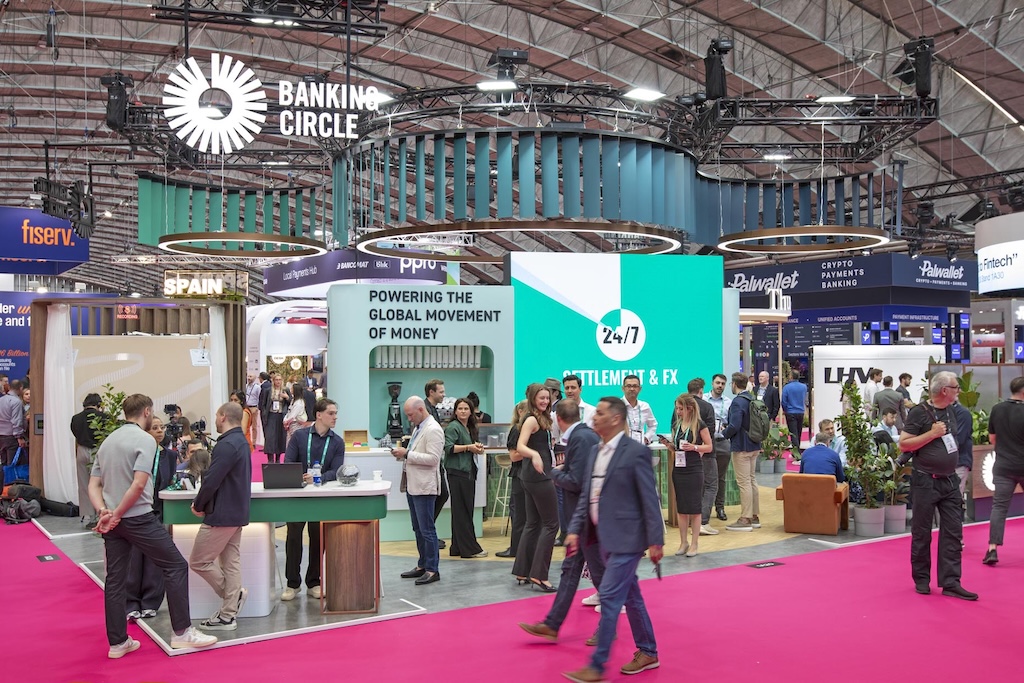
Slapping a premium espresso machine on a standard hired counter does not make it a VIP experience. It’s the architecture itself that has to do the heavy lifting. When designing the footprint for Banking Circle at Money20/20, for example, the brief was to construct a high-functioning hospitality venue. By strategically zoning the footprint into a high-energy open cocktail bar, a premium barista station, and acoustically treated meeting areas, the architecture actively controlled the psychology of the floor. It gave casual visitors a vibrant place to network while protecting the high-level deal-making happening in the back.
Exclusivity is just as critical as visibility. For TrueLayer, the objective was purely confidential deal-making. The solution was a privatised sanctuary where VIPs could check in and experience secure demos away from passing traffic. Executive meeting durations increased significantly as a result of actively designing the space to shut out the visual clutter and frantic energy of the exhibition hall.
In a private members’ club, the most valuable real estate is the private dining room, and so, your trade show space should function exactly the same way.
The ROI of Spatial Psychology
The financial pressure on event teams has never been higher. According to Gartner’s latest CMO Spend Survey, marketing budgets have flatlined at just 7.7% of company revenue, while Amex GBT reports that 71% of planners are simultaneously battling rising per-delegate costs. Because of this squeeze, every square metre must be psychologically engineered to keep high-value targets in your space longer. This level of architectural exclusivity is a direct driver of commercial ROI.
Every pound spent on a physical footprint is now directly competing with digital media, meaning the C-suite expects a trade show ROI of between 300% and 500%. Yet, Bizzabo’s latest benchmark report reveals a staggering 40% of organisers still cannot prove any tangible ROI to their procurement teams.
Why? Because they are measuring the wrong things.
They rely on screens to harvest raw, low-intent badge scans instead of facilitating human connection. To prove the ROI of a ‘Soho House’ experience to a CFO, you have to change the metrics. You stop counting the sheer volume of fleeting, five-minute interactions, and start tracking dwell time, executive meeting duration, and the seniority of the guests staying in your space. When an acoustically treated sanctuary keeps a Tier 1 prospect engaged in confidential deal-making for 45 minutes, that is a measurable metric that translates directly to pipeline velocity.
You might have the budget for a visually striking, ultra-contemporary build. But if you skimp on the human experience inside it, you have effectively built the activation backward. The exact quality of the coffee beans matters. The glassware holding the cocktails matters. Pulling this off requires an agency partner who obsessively sweats these details and understands how to weave a premium feel into the physical flow of the space.
It is time to stop measuring your agency by how much wood they can build for your budget, and start measuring them by how their spatial design converts footfall into closed-won revenue.
Mark Hutchinson is managing director of INCEPTION Worldwide, with more than 15 years’ experience creating events and brand experiences for global clients, combining strategic thinking with creative design to build lasting connections with audiences.