
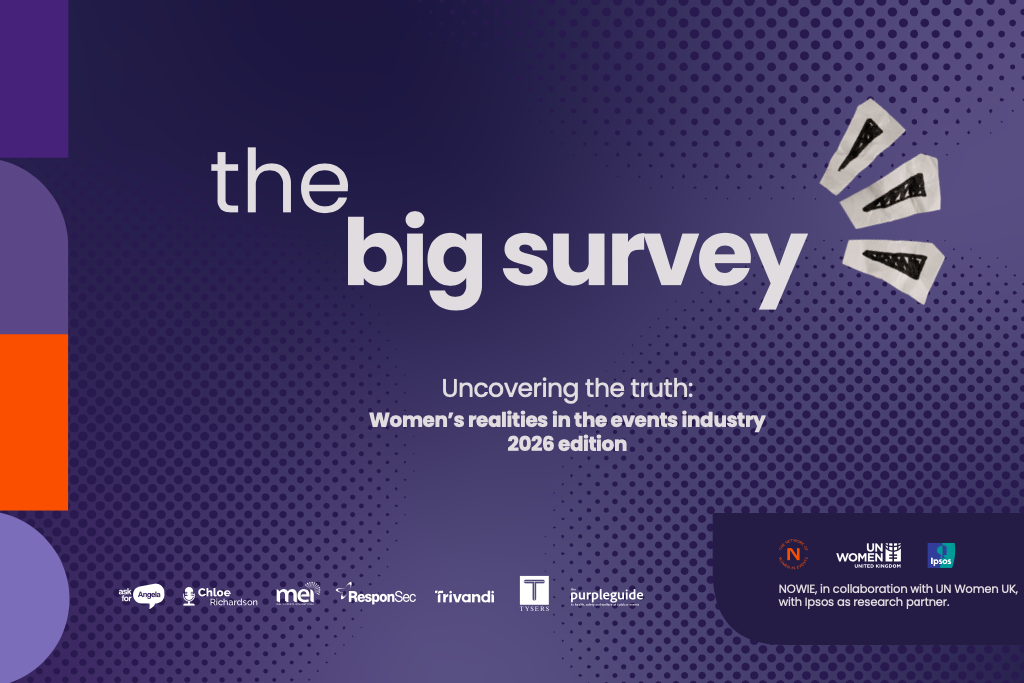
More than six in ten women surveyed by the Network of Women in Events (NOWIE) did not report the most significant harassment incident they experienced, according to new research highlighting gaps in safeguarding across the sector.
The Big Survey 2026 found that 80% of women respondents had experienced harassment on site at an event, while 19% had left a role or turned down work because of safety or harassment concerns.
Produced in collaboration with UN Women UK, with Ipsos as research partner, the report draws on 519 responses, including 476 women. Men were invited to participate for the first time, alongside non-binary respondents and those who preferred not to disclose their gender.
Although 86% of women described the events industry as a safe or mostly safe working environment, the findings reveal widespread experiences of inappropriate behaviour, particularly when working on site.
Some 62% had experienced comments about their appearance, catcalling or whistling at an event, and the same proportion had experienced sexist or misogynistic remarks. A third reported unwanted physical contact, while 6%, representing 27 women, reported sexual assault on site.
Barriers to reporting
Among women who did not report their most significant incident, half said they did not think it was serious enough, while 37% were worried about their career prospects or future work. Just over a quarter did not know how to report it or who to tell.
Only 51% of respondents knew their employer had a formal harassment policy. Among those who did have a policy, just 38% believed it was genuinely enforced.
The report also found that 83% did not know what happens to a perpetrator after a report is made.
Freelance and self-employed women reported similar levels of on-site harassment to employed women, at 81% and 79% respectively. However, only 28% knew of a clear reporting process, compared with 64% of employed women.
Risks also extended beyond the event itself, with 40% of respondents reporting an incident outside working hours, while travelling to or from a job or staying away for work.
Turning findings into action
The research points to a willingness to intervene, with 89% of respondents who had witnessed harassment taking some form of action, including supporting a colleague afterwards, intervening directly or reporting what they saw.
However, 53% of respondents had never received training in harassment awareness, bystander intervention or safeguarding.
NOWIE is planning to launch Safe to Work, an industry improvement initiative providing policy templates, recommendations for designated safeguarding leads, a reporting framework and training tailored to the events sector.
The report urges employers to make policies and reporting routes visible, identify an approachable contact at every event, extend safeguarding to work-related travel and accommodation, and include freelancers in training and briefings.
It also calls on government and industry to explore an independent, confidential reporting route for the events workforce. Some 98% of respondents said they would use or consider using such a body.
In her foreword, NOWIE managing director Cat Kevern said: “I hope this report will do more than just inform conversations; I hope it will inspire real action.”
The survey was conducted anonymously online between 17 June and 28 July 2026. Participation was voluntary and self-selecting, and NOWIE cautions that the findings reflect respondents’ experiences rather than being representative of the entire events workforce.