
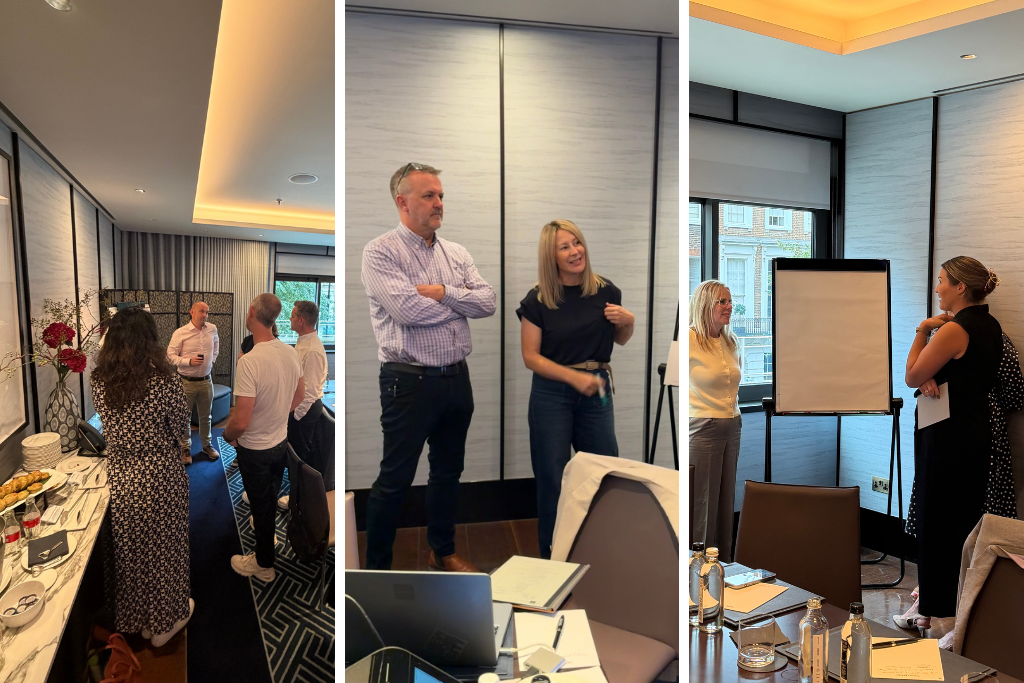
micebook brought together members of its nineteen Agency Leaders community at Nobu Hotel London Portman Square last week for an afternoon of open discussion and peer-to-peer problem solving, followed by dinner at the hotel.
The session focused on some of the biggest challenges currently facing agency leaders, based on feedback from the community around what’s keeping them up at night.
Client unpredictability and cash flow, growth and scaling, talent and retention, and creativity, AI and efficiency had emerged as the four key areas, with growth and scaling generating particularly strong interest on the day.
Breaking into smaller groups, leaders were asked to share real examples of the challenges they are facing within their own businesses, before coming back together to discuss solutions and approaches that have worked for them.
Don’t grow for growth’s sake
Growth and scaling proved a hot topic, with discussions ranging from organic growth and acquisitions to culture, talent and client concentration.
One of the strongest messages was the importance of being clear about why you want to grow in the first place.
Being bigger isn’t necessarily better, and leaders acknowledged that scaling an agency inevitably changes both the business and the role of its founder. As teams grow, agility can reduce, infrastructure increases and leaders often find themselves spending less time doing the parts of the job they originally loved.
Sustainable growth was another key theme. Leaders discussed the risks of investing heavily on the back of a major client win, only to lose that business further down the line, as well as the importance of avoiding over-reliance on a single client, sector or relationship.
Culture was seen as critical, particularly when it comes to acquisition. While culture will inevitably evolve as a business grows, leaders agreed that staying true to the values at the heart of the agency and bringing people on the journey is key.
The people challenge keeps changing
Flexible working remains a particular balancing act, as agencies try to respond to changing employee expectations while finding a model that works for the business.
There was also discussion around career progression, how to keep long-standing employees feeling valued, and the difference between learning a skill and developing the experience needed to become an expert.
The importance of tailoring recognition to the individual also came through strongly. One leader shared how they ask every new employee how they like to be recognised, acknowledging that while some people value public praise, others prefer recognition to be given privately. It was a simple idea that resonated with many around the table.
Creative talent emerged as an interesting area of concern. With many senior creatives choosing freelance careers, leaders questioned whether the industry is doing enough to build the next generation of creative directors.
Rather than focusing predominantly on event management students, the group discussed reaching young people studying design, 3D, gaming and film, potentially from school age, and showing them the breadth of creative careers available within the events industry.
Rethinking the RFP
Client payment terms, procurement and RFPs prompted plenty of discussion, with leaders sharing examples of long payment terms, delayed POs and agencies having to fund significant event costs while waiting to be paid.
One practical takeaway was the importance of establishing the right escalation contacts at the outset of a client relationship, particularly around finance and procurement. Rather than waiting until a payment problem arises and relying on the day-to-day client contact to find the right person, agencies should know from the start who to go to if an issue needs escalating.
There was also frustration around the time and resource invested in pitches, particularly when agencies suspect an RFP may primarily be a benchmarking exercise.
One leader revealed that their agency had calculated it spent 125 hours responding to a recent pitch, prompting discussion around whether agencies need to be more transparent about the true cost of pitching.
The group also discussed the need for greater client education around how to run an effective RFP and get the best from agency partners, alongside a move away from simply comparing rate cards towards conversations around value and outcomes.
It’s a subject micebook will be exploring further as part of a planned project around RFP best practice.
The conversations continued over a delicious dinner at Nobu Hotel London Portman Square, giving members more time to connect, share knowledge and continue some of the discussions started earlier in the day.