
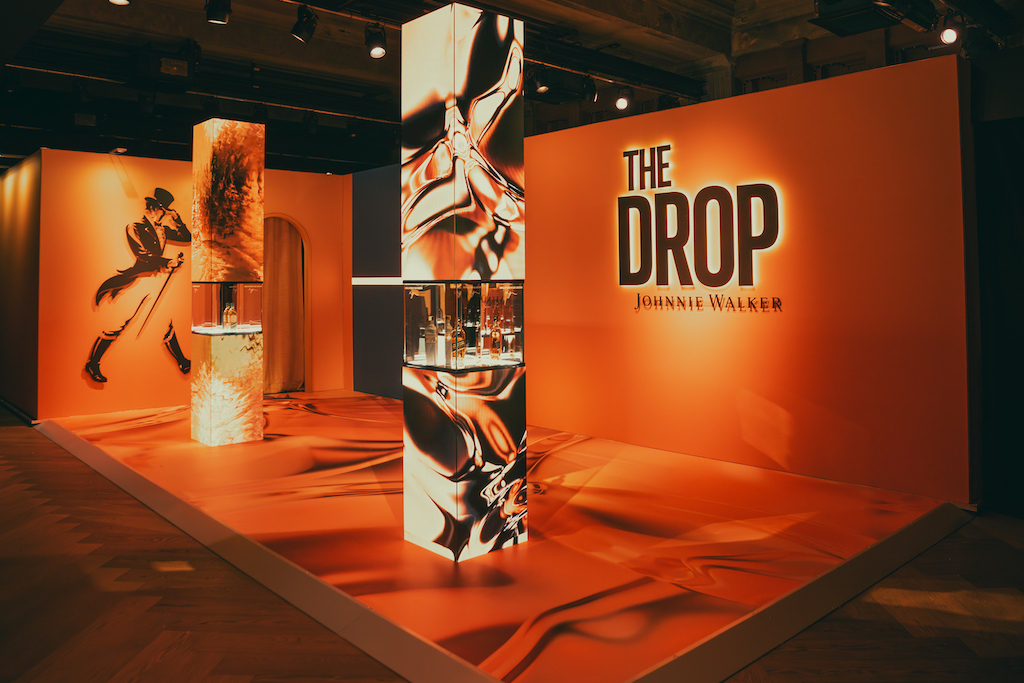
Part gallery, part tasting lab and part stage, The Johnnie Walker Drop reimagined traditional trade advocacy through a multi-sensory combination of motion art, sound, light, flavour and bartender-led storytelling.
Created by Chorus for Johnnie Walker, the multi-city, multi-format platform was designed to deepen brand love among bartenders and hospitality professionals while building lasting connections with the global drinks’ community.
The concept, which took home the Best Creative Concept award at the micebook Awards 2026, was first piloted through a series of activations before being brought to life at Edinburgh Bar Show in April 2025, hosted at Johnnie Walker Princes Street.
Rethinking trade advocacy
The brief was to re-establish Johnnie Walker as a favourite among bartenders, strengthen its presence at international bar shows and create something the trade would talk about.
Chorus responded by treating bartending as a creative discipline in its own right. Rather than building the experience exclusively around the drinks industry, the agency partnered with cultural collaborators working across digital art, music, lighting and photography to offer new interpretations of Johnnie Walker’s whiskies.
The collaborators were chosen for their experimental approach and ability to challenge conventions within their respective fields. By bringing those perspectives together with the craft of bartending, Chorus aimed to create an experience that felt culturally relevant while remaining rooted in the product.
A journey through four creative chapters
The Edinburgh experience was designed as a four-part journey, with each space serving a distinct purpose and creating a different emotional response.
The first chapter, Liquid Dynamics, acted as an attractor, using bold visual identity, atmosphere and digital artwork by artist Zach Lieberman to draw people into the brand world.
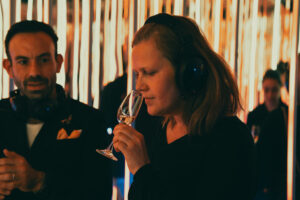
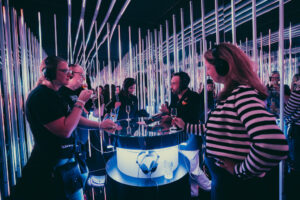
From there, guests moved into Flavour Immersion, where a bespoke soundtrack by electronic music producer Halina Rice was combined with an architectural lighting system designed by Carlota Nunez-Barranco. The sound and lighting responded to the tasting notes of the whisky in real time, translating flavour into a multisensory experience.
The third space, Brand Me, shifted the focus onto the bartenders themselves. Portrait-led photography by Tarek Mawad gave attendees professionally created content they could use to support their own personal brands.
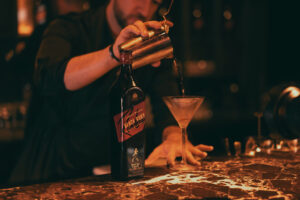
The journey concluded at Reset the Bar, an inviting and more human space where guests could connect and continue conversations over cocktails created by world-class bartenders.
This final interaction was an important part of the concept. Technology, art and design created the spectacle, but the experience always returned to the relationship between the guest, bartender and liquid.
Designed to travel
From the outset, The Johnnie Walker Drop was conceived as more than a one-off activation. Chorus developed it as a flexible creative system that could move between cities, adapting to different markets, spaces, budgets and objectives without losing its identity.
Working with exhibition specialist Taylex, the agency used a modular building system to engineer the four environments. Scenic and structural elements could be packed, reconfigured, reskinned and rebuilt, allowing each market to create a locally relevant interpretation while maintaining global consistency.
Operational playbooks covering everything from uniforms and marketing to appointment booking, bartender scheduling and guest flow also enabled local teams to deliver the experience consistently.
That adaptability was tested at Athens Bar Show, where Chorus had just five weeks to redesign and deliver the activation for a very different environment.
Unlike the highly orchestrated, multi-space Edinburgh edition, Athens required a streamlined experience suitable for a busy trade-show floor. Chorus reused and reconfigured existing elements, retaining the core flavour, storytelling, photography and bar chapters while reducing the technical and architectural layers.
The result demonstrated that The Drop could operate on a smaller footprint and at a faster tempo without diluting the central creative idea.
Extending the experience through VR
To take The Drop to markets and events where the full physical build was not practical, Chorus also created a virtual reality tasting experience.
Developed with Johnnie Walker master blender Emma Walker, global brand ambassador Tim Philips-Johansson and digital artist Zach Lieberman, the VR chapter guided guests through responsive visual worlds inspired by flavour.
The experience was preloaded onto Meta Quest 3 headsets and combined with a physical tasting ritual hosted by local teams or brand ambassadors. A complementary bar experience, led by local bartenders serving Johnnie Walker cocktails with a regional twist, maintained the human connection at the heart of the wider platform.
The VR experience was not intended to replace face-to-face interaction. Instead, it offered a portable and cost-effective way to bring the art, sound and storytelling of The Drop to trade shows, training sessions and market activations around the world.
Creative thinking with measurable impact
The modular approach allowed Chorus and Johnnie Walker to reduce production time, costs and waste through the reuse and reskinning of existing elements.
According to the award entry, carbon emissions across the four global bar-show activations delivered by Chorus fell by more than 71% between 2024 and 2025. The Edinburgh event also topped Johnnie Walker’s global social channel charts for both story mentions and in-feed tags across paid, earned and owned media.
“The Drop doesn’t just platform whisky, it showcases bartending as culture,” said Chorus. “It turns advocacy into an art form designed to travel.”
The micebook Awards judging panel praised the concept for balancing cultural relevance, storytelling and scalability with Johnnie Walker’s wider brand purpose and strategy.
One judge described it as “a rich and engaging creative platform that reimagines trade advocacy in a way that feels genuinely exciting and meaningful”, while another highlighted the modular approach as “exactly how you scale a global platform without losing brand integrity”.