
By Susie Harwood
An old editor of mine used to say there’s no such thing as a merger – it’s always one company buying another.
When it was announced back in December, the deal between OrangeDoor and Unbridled was framed very much as a merger and described as “a meeting of minds”.
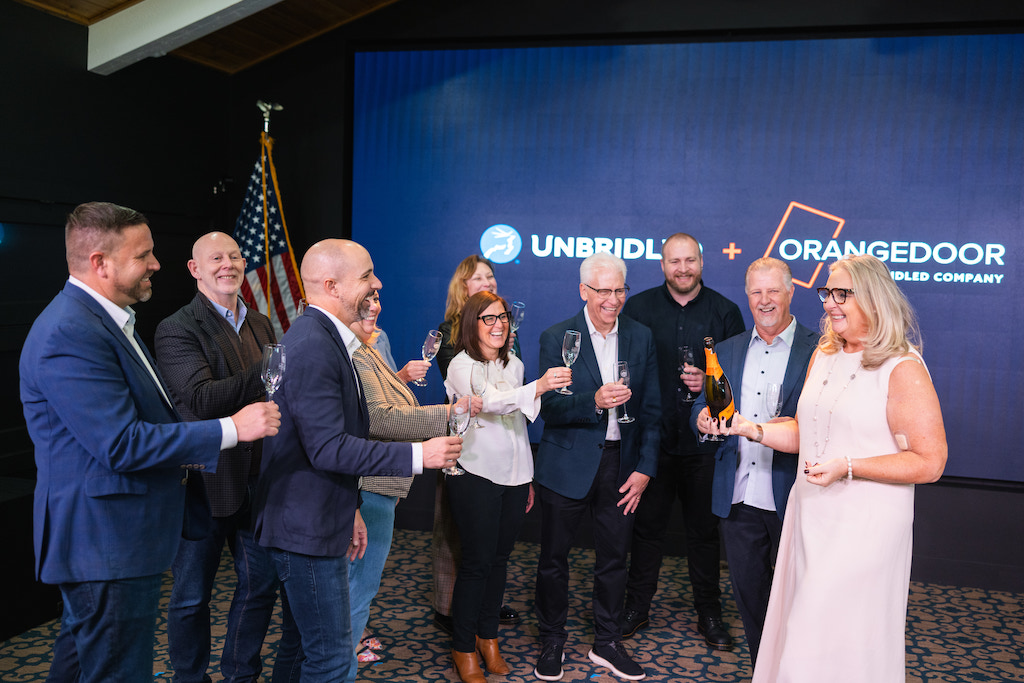
In this case, ultimately Unbridled is the acquirer. But four months on, sitting down with the combined leadership team at OrangeDoor’s office, it doesn’t feel like a takeover story.
The mutual respect and trust between Unbridled founder Stan Bullis, Scott Lucius, Partner & Chief Commercial Officer at Unbridled, and OrangeDoor founder and CEO Elizabeth Heron, is immediately clear.
Has it really all been plain sailing so far? “We haven’t had a fight yet,” says Bullis. “We’ve quickly settled into healthy lanes. Scott’s our business leader, Elizabeth’s the evangelist, and I’m probably the philosopher.”
Lucius adds: “And Andrew [Winterburn, OrangeDoor MD] has done this before. A lot of our confidence in this merger comes from the fact that he has led international M&A at scale. So, I know there’s somebody who has my back that will steer me in the right direction.”
It doesn’t feel like two businesses tentatively learning to work together. If anything, it feels quite the opposite.
The companies were already working together before the deal had even completed.
Since then, that collaboration has only accelerated. The teams have pitched together, delivered projects across both markets, and supported each other operationally.
So, what sets this acquisition apart?
A different kind of deal
The events sector is in the middle of a new wave of consolidation, with private equity and VC-backed groups driving a push towards global growth scale.
But alongside the increased M&A activity has come a familiar pattern: cost-cutting, restructuring, and, in some cases, cultural challenges. A recent trends report by event recruitment specialist Robert Kenward points to a turbulent first quarter in the UK agency market, with redundancies and resignations following a wave of post-M&A restructuring.
Bullis believes that much of that activity is being driven by economics as much as strategy. “The business of delivering events is expensive,” he says, pointing to rising costs across travel, accommodation and production. “Mergers can often be a cost-saving initiative to counter that.”
Heron is candid about what she’s seen elsewhere in the market. Many mergers, she says, end up losing the very thing they set out to acquire – people, culture, and, ultimately, purpose.
By contrast, OrangeDoor has grown since the deal, expanding its team by around 25% and continuing to recruit. “It’s important to not discount the burden of debt,” adds Bullis.
“We’re debt free, so we’re able to move in line with where the market is going. Hence why we’ve added 25% of the workforce here. And we’re launching an exhibition division, because we believe there will be a big boom in the exhibition and trade show sector.”
A merger eight years in the making
Unbridled is not a business that typically grows through acquisition. Since its founding, the group has expanded to more than 30 companies across sectors including travel, construction and wealth management. But almost all of that growth has been organic. Prior to OrangeDoor, there had only been one acquisition in more than two decades, because “we struggled to find people that thought like us,” explains Bullis.
“We’ve found much more success in starting our own businesses, because you can’t replicate culture,” adds Lucius. “This was the first time in a long time that we met a company where there was that level of alignment, so we didn’t have to build it from scratch.”
The search for a European partner was equally deliberate.
Unbridled had been looking to expand into the UK and wider EMEA market for nearly eight years before a chance meeting between Andrew Winterburn and a former colleague who now works at Unbridled, led to the two companies getting together.
Lucius says that from the very first presentation with Elizabeth, the businesses recognised a shared way of working: non-hierarchical, collaborative, and built around people rather than process.
Culture as a starting point, not a challenge
If many mergers and acquisitions fail on culture, OrangeDoor and Unbridled believe that’s exactly where theirs starts.
“A lot of mergers try to force cultures together. This didn’t feel like that at all. When we talked about the cultures coming together, it was very natural,” says Heron. “We were absolutely aligned in how we work and in our ways of being, so our starting point on culture was already incredibly high.”
That doesn’t mean there hasn’t been work to do. Integration is still ongoing – systems IT, and processes and teams are being aligned.
In fact, the reason Bullis and Lucius were in the UK was to share Unbridled’s culture and values with the wider OrangeDoor team. But the approach has been deliberately light touch.
“It’s not about putting our culture onto OrangeDoor,” says Lucius. “It’s an invitation into the community and the language that we’re using. It doesn’t have anything to do with changing the way that people work, because we’ve already worked so similarly, but just having that shared language so that we have a path forward.”
OrangeDoor has also adopted Unbridled’s 20:20:60 model – an approach that allocates 20% of profits to charitable initiatives, 20% back into the business, and 60% to shareholders. Bullis traces its origins back to a simple question: “what would it look like if business behaved in the way we expect governments to?”
It’s not something the company actively markets, as the priority remains to deliver excellence for clients. Instead, it sits behind the scenes, part of the culture rather than a headline.
Winning over clients
On the subject of clients, if there was any scepticism about the merger and how it would be received, it hasn’t lasted long.
Heron recounts a recent conversation with a senior client from a global tech company. “She admitted to me that she was sceptical about my initial enthusiasm about the merger. But having met Scott and Stan, and spent time with us together a few months in, she could feel that the respect and trust was genuine.”
More broadly, the merger has shifted the nature of client conversations. For OrangeDoor, the immediate benefit has been scale, particularly in the US market, where Unbridled’s footprint opens new opportunities.
For Unbridled, it’s the reverse: the ability to offer clients a credible, on-the-ground presence in the UK and Europe.
In both cases, it’s enabling relationships to deepen and expand globally.
What next?
It’s still early days, and for now the focus is on getting the integration right. OrangeDoor has clear ambitions, including expanding into new verticals and strengthening its offer across exhibitions, production and venue finding. A move to a new London HQ is also on the horizon, with the business starting to outgrow its current Bromley base.
Alongside that, there are plans to expand geographically. “We want to be a global company, but we have to do this right first,” says Bullis. “We can’t move on to the next step until we’ve got this right.”
Europe is the immediate priority. For Lucius, the next phase is about building a stronger presence in the region before looking further afield. But unlike many of their competitors, growth won’t be driven by a rapid acquisition strategy.
“There’s no interest in just buying our way into new markets,” says Heron. “It must be the right people, the right culture. If that’s not there, it’s not the right move.”
That approach is closely tied to the group’s broader model. “We’ll remain debt-free,” adds Lucius. “That’s important to how we operate.”
For now, the priority is balance – managing growth without losing the culture that underpins it.