
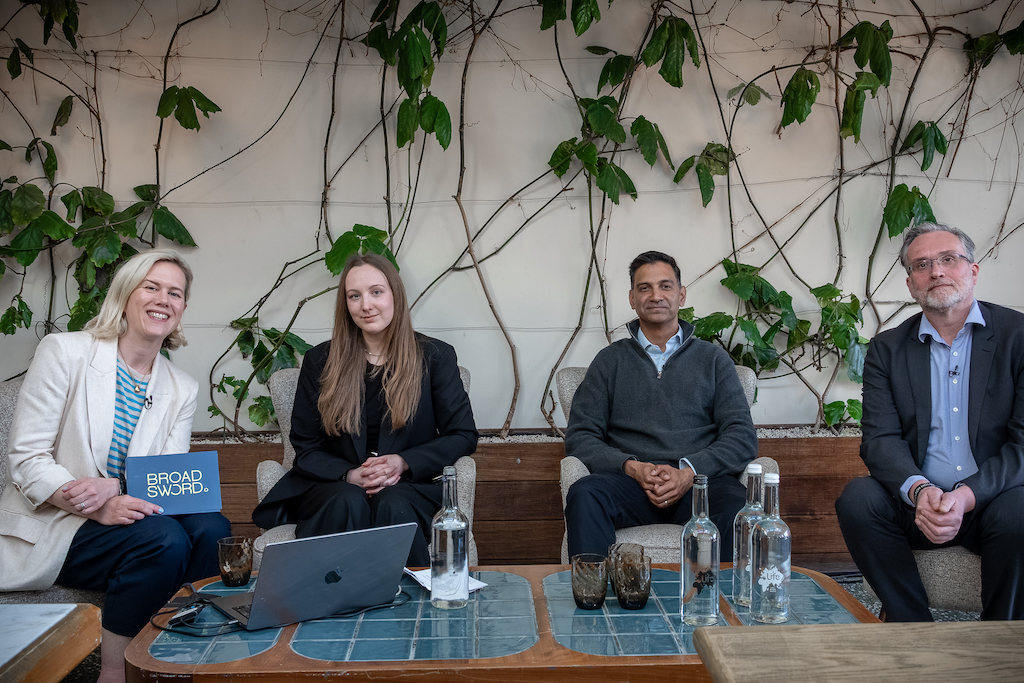
Broadsword hosted its first B. Inspired event of 2026 at Shoreditch House, bringing together event and marketing leaders to explore a topic shaping modern marketing: The Engagement Economy.
The session focused on how live experiences drive meaningful engagement, deliver against evolving marketing metrics, and demonstrate long-term ROI as one of the most impactful channels available today.
Diane Carters, head of commercial development at Broadsword, was joined by a panel of three B2B leaders from the financial services sector to share how they are delivering events that drive measurable business impact and stronger customer relationships.
The panellists were Kimberley DeRudder, head of global marketing campaigns at ComplyAdvantage, Jonathan Dewe, senior director and head of global events at Moody’s and Aman Luther, head of technology at Loan Market Association.
Trust as a Lever for Growth
A central theme throughout the session was trust – not as a soft metric, but as a critical driver of growth.
Kimberley highlighted the difference between transactional and relationship-led engagement with an anecdote: “Let’s say you are at an industry trade show, and someone just came up to you and started pitching their solution. In this instance that person would represent a vendor. They are instantly trying to sell you their product. Instead, if that someone asked you, “what is keeping you awake at night?” they are starting to understand your problems, like a partner.”
Jonathan reinforced that trust is built over time and multiple touch points, not in isolated moments or one flagship event. Events play a critical role in building and maintaining trust, which can be “hard to build and very easy to lose.”
Aman added perspective from a membership organisation, describing the challenge of balancing different stakeholder needs within a single environment—creating spaces where both buyers and vendors can interact meaningfully, without compromising trust. “How can we successfully get lions in there who want to sell and the zebras who don’t want to be eaten, but they do want to kind of interact and have those conversations?” Ultimately, it becomes a balance between return on investment with return on experience in that context as well while bringing more people into the conversation.
Across the panel, the message was clear: trust is built through consistent, high-quality interactions across multiple touch points.
Live Experiences & Mental Availability
The panel explored the unique role of live experiences in building mental availability, creating memorable interactions that shape long-term brand preference.
Kimberley shared how ComplyAdvantage’s global event series ‘Catalyst’ on the future of financial crime compliance, focused on facilitating connection rather than promotion. One session brought together a criminologist and an ex-criminal to speak to an audience of financial crime professionals — moving beyond data to create a memorable perspective shift. Rather than selling, the focus was on sharing perspectives and building genuine connection.
“Really the goal for us was to facilitate networking and connections, making sure that we give our sales team a front row seat to our audience’s challenges. They were not selling to them, they were learning with them.”
By shifting the focus away from selling and towards shared learning, events become a platform for deeper engagement and stronger relationships.
Designing for Trust
Delivering trust at scale requires intentional design. Moody’s approach to a global event playbook highlighted how consistency can be maintained across hundreds of events while still allowing flexibility for local markets. The goal is not rigid standardisation, but a framework that ensures the brand shows up consistently, wherever the event takes place.
Similarly, Aman emphasised the importance of deeply understanding audience needs and taking a long-term view, designing events that evolve into trusted industry platforms over time.
Ultimately, events should be treated not as standalone moments, but as strategic brand assets.
Measuring What Matters
While events are widely recognised as impactful, measuring their value remains a challenge.
The panel discussed the need to move beyond short-term metrics and focus on long-term indicators of engagement and relationship strength, for example. Using a Net Promoter Score (NPS) as a leading indicator to understand whether relationships are progressing, and audiences are becoming more engaged over time.
Furthermore, there is an importance of tracking engagement across the full customer journey, looking at how audiences interact both live and digitally throughout the year.
As a leader in technology, Aman pointed to the future of measuring granular engagement, comparing it to football analytics that track every element of the game— the ball, the players, the movements. For events, this could mean understanding “who an attendee spoke to first” or “which stands they spent the most time at.”
As he put it, “If we can get that same level of analysis for attendance and interactions at live events, that would be game changing.” He added that a less intrusive approach could involve RFID-based tags, allowing organisers to track movement throughout an event without relying on facial recognition.
Closing Reflections
To close the session, the speakers each gave their top tips for driving commercial value:
Kimberley: “Avoid planning events as a one-off activity. Make sure it’s part of your final multi-channel campaign plan and plan a robust follow up plan rather than just a one-off report”, “Tailor the event for your audience needs. Don’t just fulfil company objectives but make sure to provide the best experience possible. Can it be fun and interactive? Can you make it a community event rather than a corporate event?”.
Aman: “Understand who your customer is and understand what’s important to them. And the second thing would be thinking long term. So don’t just think about this year’s event, think about future events and really think about it as an arc of that, that customer’s relationship with you as opposed to this one particular interaction. If you keep those two things in your mind, you’ll probably not go wrong.”
Jonathan: “Live events are very valuable. We’ve got to start to re-educate CFOs into the value that’s offered there and that takes time. Create a story that is a financial story for them, so that when it comes to budget, we can justify our spend”.