
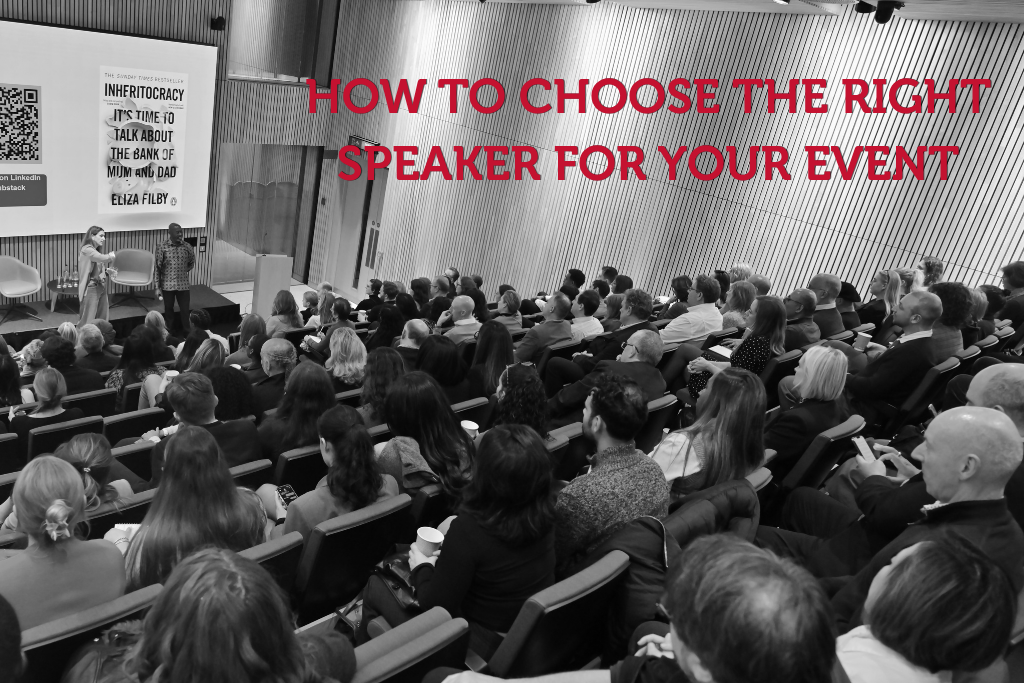
micebook partner Speakers Corner shares insights on how to find the right speaker to elevate your next event, and get the results you want…
For experienced event organisers, choosing a speaker is rarely a logistical decision. It is a strategic one.
At its best, the right speaker does not simply deliver a session. They shape how an audience interprets the event itself. They influence the conversations that happen afterwards. They can accelerate alignment, challenge assumptions, or create the kind of momentum that carries well beyond the day.
And yet, despite the importance of that role, speaker selection is still often approached through relatively simple categories. Keynote. Motivational. Host. Facilitator.
These labels are useful as shorthand, but they can also be limiting. They describe what a speaker does in broad terms, rather than what they actually deliver in a specific moment, for a specific audience, within a specific context.
For organisers working at a senior level, the challenge is no longer about understanding those categories. It is about moving beyond them.
Starting in the right place: clarity before choice
The most effective speaker decisions tend to begin in the same place: not with the speaker, but with the outcome.
What needs to be different after this event?
That question sounds simple, but in practice, it is where much of the value is created or lost. Because without a clear answer, even the most engaging or high profile speaker risks landing as a moment rather than making an impact.
In many cases, events are expected to achieve multiple objectives at once. They may need to communicate strategy, align teams, introduce new thinking, and re-energise an audience that is already balancing competing demands. The pressure to deliver against all of these can lead to broad or vague briefs, where the expectation placed on the speaker is to “inspire”, “inform”, or “set the tone”.
The difficulty is that these outcomes are too open to interpretation.
Clarity comes from going a level deeper. Understanding not just what the event is about, but where the audience currently is in their thinking, what tension or uncertainty exists, and what shift would make the most meaningful difference.
In that context, the role of the speaker becomes much more precise. They are no longer filling a slot in the agenda. They are helping to move the audience from one place to another.
The shift in expectations: from content to interpretation
Part of the reason this matters more now is that the role of content itself has changed.
Access to information is no longer a constraint. Most audiences arrive with a baseline level of knowledge, often shaped by continuous exposure to industry updates, internal communications, and increasingly, AI-driven tools that surface insight instantly.
What is in shorter supply is interpretation.
How does this apply here? What does it mean for us? Which signals matter, and which can be ignored?
This is where the role of the speaker has evolved.
A decade ago, delivering high quality content may have been enough. Today, content without context rarely lands. Audiences are not just listening for information. They are listening for relevance, for clarity, and for a perspective that helps them navigate complexity with more confidence.
At the same time, attention has become harder to hold, not in a dramatic sense, but in a subtle, constant way. Even in well designed events, audiences are balancing competing demands, both external and internal. The assumption that a room will remain fully engaged throughout a session is no longer a given.
Which raises the bar further.
A strong speaker is not just someone who knows their subject. It is someone who can hold attention, interpret complexity, and make what they are saying feel immediately relevant to the audience in front of them.
Rethinking return on investment
In parallel with this shift, the way organisations think about return on investment has also become more sophisticated.
ROI is still discussed frequently, but it is often framed in broad or simplified terms. Attendance numbers, feedback scores, and overall satisfaction.
These metrics have their place, but they do not always capture what matters most.
A more useful way to think about return is to consider the different layers of impact an event, and by extension a speaker, can create.
The first is attention. Without it, nothing else follows. A speaker who can genuinely hold a room creates the conditions for everything else to land. This is often underestimated, but in an environment where attention is fragmented, it is a critical foundation.
The second is alignment. Particularly in larger organisations, one of the most valuable outcomes of an event is a shared understanding. When people leave with a common language, a clearer sense of direction, and a better grasp of what matters, it reduces friction and supports better decision making over time.
The third is a behavioural shift. This is where impact becomes more tangible. Are people approaching their work differently? Are they applying what they have heard in a meaningful way? This is more difficult to measure, but it is where the real value of many speaker sessions sits.
Finally, there is a commercial or strategic impact. In some cases, this may be direct. In others, it may be more gradual, influencing culture, performance or long term direction. The closer the connection between the speaker’s message and the organisation’s objectives, the clearer this becomes.
When viewed through this lens, the question is not whether a speaker was “good”. It is whether they contributed to these outcomes in a meaningful way.
Matching the speaker to the moment
With that in mind, the process of selecting a speaker becomes less about category and more about fit.
Every event has its own rhythm. Points where clarity is needed. Moments where energy dips. Opportunities to challenge thinking or reinforce direction.
Understanding where those moments sit and what is required within them is where much of the value lies.
For example, an opening session may need to provide a framework that helps the audience make sense of everything that follows. In that context, the speaker’s ability to interpret and connect ideas becomes more important than simply delivering insight.
A mid-agenda session may need to re-engage attention, but in a way that still ties back to the overall purpose of the event. Energy matters here, but so does relevance.
A closing session may need to bring coherence, helping the audience reflect on what they have heard and what it means for them going forward.
In each of these cases, the most suitable speaker may not fit neatly into a single category. What matters is their ability to deliver against the specific requirement of that moment.
Where even experienced organisers can be caught out
Even at a senior level, there are a few common patterns that can reduce the impact of a speaker.
One is the pull of profile. A well known name can add credibility and help drive attendance, but it does not guarantee relevance. If the content does not connect with the audience’s context, the impact is often limited to the moment.
Another is overestimating the value of delivery style in isolation. An engaging speaker can create a positive experience, but without substance or alignment, that experience does not always translate into lasting value.
There is also the question of timing. When speakers are brought in late in the process, there is less opportunity to shape their content in line with the broader narrative of the event. In contrast, involving them earlier allows for a more integrated approach, where their contribution is part of the overall design rather than an addition to it.
Finally, there is the issue of the brief itself. Broad or generic briefs tend to produce broad or generic outcomes. The more clearly the objective is defined, the easier it becomes to find a speaker who can deliver against it.
Where the right support makes a difference
For many organisers, this is where an external perspective becomes valuable. Not because the options are unclear, but because the nuance sits in the detail.
At Speakers Corner, we work alongside event teams to shape this thinking from the outset. That means going beyond simply recommending names, and instead understanding what you are trying to achieve, how your audience is likely to engage, and where a speaker can have the greatest impact.
Our approach is impartial, drawing on a wide network of speakers rather than a fixed roster, and focused on finding the right voice for the moment. Just as importantly, we stay close throughout the process, from initial brief through to delivery, ensuring everything aligns with the outcome you are working towards.
A more useful way to think about the decision
Rather than starting with the question of speaker type, it is often more useful to frame the decision around three core considerations.
First, what is the primary shift you want to create? Not just in terms of knowledge, but in terms of thinking, alignment or behaviour.
Second, where does that shift need to happen within the flow of the event? At the start, in the middle, or at the end.
And third, what kind of voice is most likely to resonate with this audience at this moment? Someone who challenges, someone who guides, someone who energises, or someone who brings clarity.
When these questions are answered with precision, the choice of speaker becomes significantly more straightforward.
The value of getting the match right
In a landscape where expectations are high and attention is increasingly difficult to secure, the role of the speaker has become more significant, not less.
But the impact they deliver is highly dependent on the quality of the match.
A strong speaker in the wrong context can underperform. The right speaker, carefully chosen and well briefed, can elevate the entire event.
That is where a more considered, consultative approach becomes valuable not just in identifying speakers, but in shaping the thinking around what is needed and why.
Because ultimately, the distinction between keynote, motivational or any other category is secondary.
What matters is the outcome.
And in an environment where events are expected to deliver meaningful, lasting value, that outcome is what defines success.