
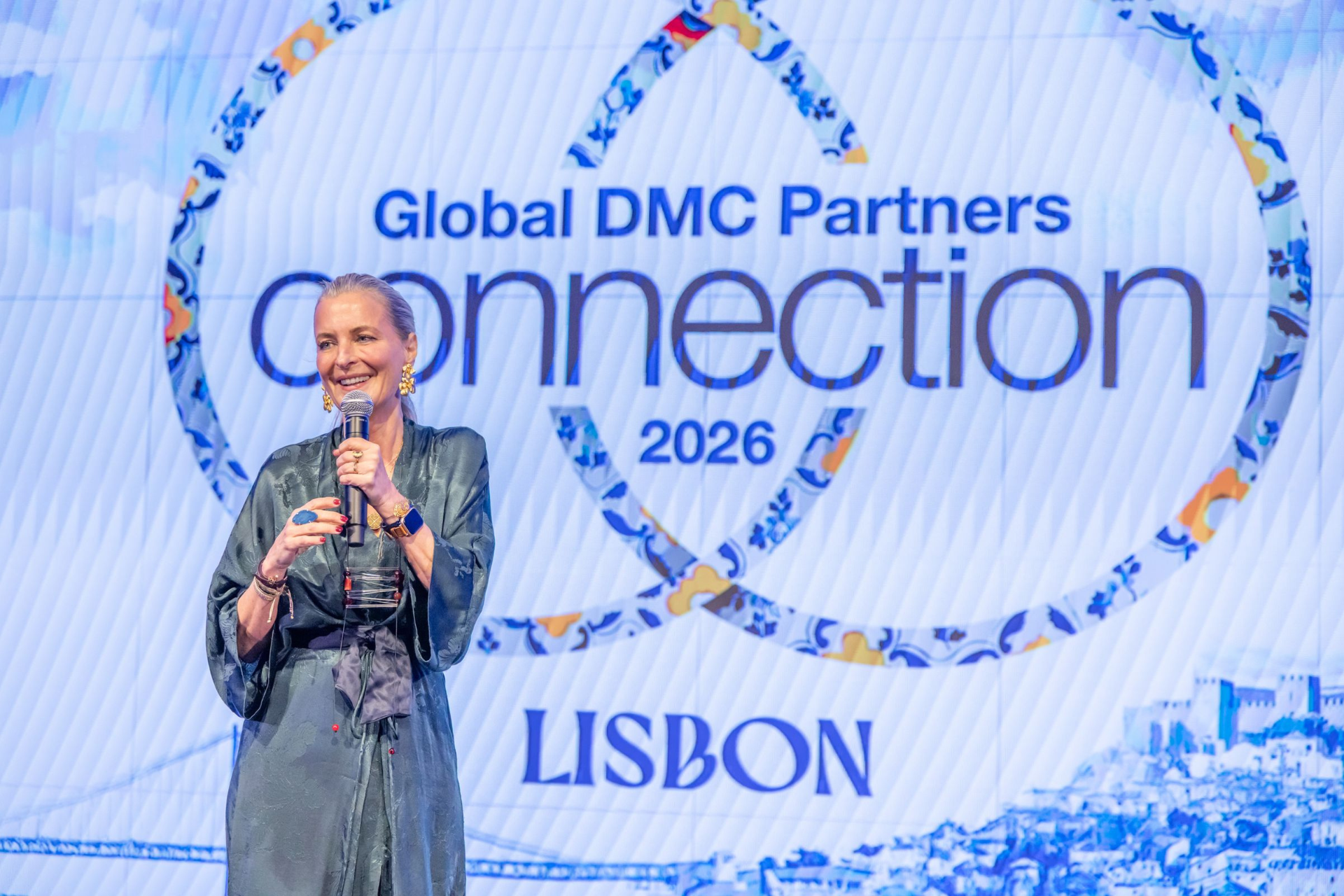
When I sat down with Catherine Chaulet, President and CEO of Global DMC Partners, at the GDP Connections event in Lisbon earlier this year, one theme kept circling back into the conversation. Uncertainty is not easing up, it has simply become part of the events industry. Geopolitics is not just something planners are reading about anymore, she says. It is shaping the logistics of their events.
“Attendees simply cannot get access to visas in some destinations,” she explains. Processing delays, shifting diplomatic relationships and reduced government staffing are all having a knock-on effect. Add tariffs, inflation and tighter client budgets into the mix and the squeeze becomes very real. “When you combine decreased budgets with higher inflation and more tariffs, it becomes a lot more complicated.”
UK planners are feeling that tension particularly strongly. Budgets are reportedly decreasing while costs continue to climb. At the same time, timelines are shrinking. “The last-minute nature of meetings puts even more pressure on planners,” Chaulet says. “They need to be able to address last-minute change and be very resilient.” Resilience, she suggests, comes from relationships, and strong partnerships are what allow planners to respond when timelines shift or regulations change.
Despite the constant evolution of digital tools, Chaulet is clear that face-to-face still wins when it comes to performance. “Companies perform better in a face-to-face environment versus virtual,” she says. “You will not have the same level of conversations.” Virtual has its place, particularly for training or efficiency. However, when discussions are nuanced or commercially critical, being in the room still matters. “It creates a sense of camaraderie and teamwork that is absolutely essential to the productivity of companies. When you need deeper exchanges where you speak about more complex situations, face-to-face is definitely the solution.”
That continued focus on impact is also driving growth at the luxury end of the market, particularly within incentives. “When you think of incentives, usually it is luxury segments,” she says, pointing to five-star hotels and higher-end experiences. “The best way to wow attendees is to treat them in unique ways, to allow them to live something that they wouldn’t live by themselves.”
At the same time, destination strategy is widening. Planners are not just looking at cost, but at freshness. “Attendees have been to certain destinations a number of times, so they want something novel,” Chaulet says. Secondary cities are increasingly part of that conversation, provided they can support group size and logistics. For those destinations to compete, she says, the fundamentals have to be in place, from meeting space to hotel capacity. Accessibility, as ever, remains a deciding factor for event planners, with rail connectivity opening up new options. “When you look at Europe, where sustainability is very important, train is a very common way of going from place to place. That opens much more opportunities for secondary markets,” she says.
Sustainability itself has evolved well beyond carbon footprints and plastic reduction. Those things are still measured, Chaulet says, but they have become a baseline rather than a headline. What is gaining ground is something more meaningful to attendees: community engagement and local impact. CSR activities that support the local economy, she says, consistently outperform other optional programme elements. “People care about the destination. They want to learn about it and make a contribution.” Unlike other activities that can attract low turnout, giving-back experiences tend to draw strong participation. “It becomes meaningful, and very often this is the part that they will remember the most.” There is a social dimension to it too. Doing something together for a community creates a sense of connection that structured activities sometimes cannot replicate.
Safety and value are also shaping decisions. “Safety is very top of mind, as well as good value for your money,” she says. Portugal continues to see strong demand, Canada is emerging more frequently in conversations, and in Asia, markets such as Cambodia and Thailand are gaining traction. In the US, direct airlift is influencing momentum. “The minute you see an airline opening from a key market such as the UK market, that destination pops up.”
AI was among the most prominent topics at GDP Connections this year. Chaulet sees practical benefits, particularly on the operational side. “There is real value in being able to use AI for the organisational part of a meeting or a conference,” she says. “It saves a lot of time.” However, she does not see it replacing planners. “The ability to think on your feet and make things happen is not an AI skill.” Programme complexity, on-site delivery and crisis management still require human judgement. In fact, she believes the role of the planner may become more visible, not less. “There have been so many articles written about AI replacing meeting planners. What we’re seeing is the other way around.”
That said, she is cautious. “AI is overwhelming. There are so many tools. What do you use? When? Can you really trust the information?” The risk is not just inaccuracy, but confidence. “We’ve seen unbelievable mistakes. There’s a balance.”
The current wave of mergers and acquisitions across the sector does not, in her view, signal instability. Quite the opposite. “There’s a lot of mergers happening, and I think some of them are really good.” Consolidation can open new markets, strengthen service capabilities and integrate technology. “They invest because they see growth potential and a good return on investment. There are so many other industries they can invest in, and right now there’s a lot of interest in the MICE industry.”
Programme design is also evolving in quieter ways. Free time is becoming more intentional. “Free time has a lot of advantage cost-wise and wellness-wise,” Chaulet says. Delegates are sometimes choosing informal connection over structured activity. “A lot of the free time people actually want to be together doing nothing. And that’s actually good networking time.” At the same time, planners are grappling with no-shows for optional activities. “People say yes, yes, and then they don’t show up,” she notes, creating wasted spend and frustration.
Looking ahead, her advice is realistic rather than reassuring. “Get comfortable dealing with uncertainty,” she says. “This is the reality, and it’s not going to change short term.” For UK event professionals navigating constant change, that means leaning into networks and speaking honestly when things feel unstable. “You need to work with people that have your back. Have honest conversations. ‘I’m struggling. The contract is not signed. I don’t know what to do. How can you help?’” The events industry, she believes, remains built on connection. “In the end, our industry is all about the connections that we make. You’re not alone.”