
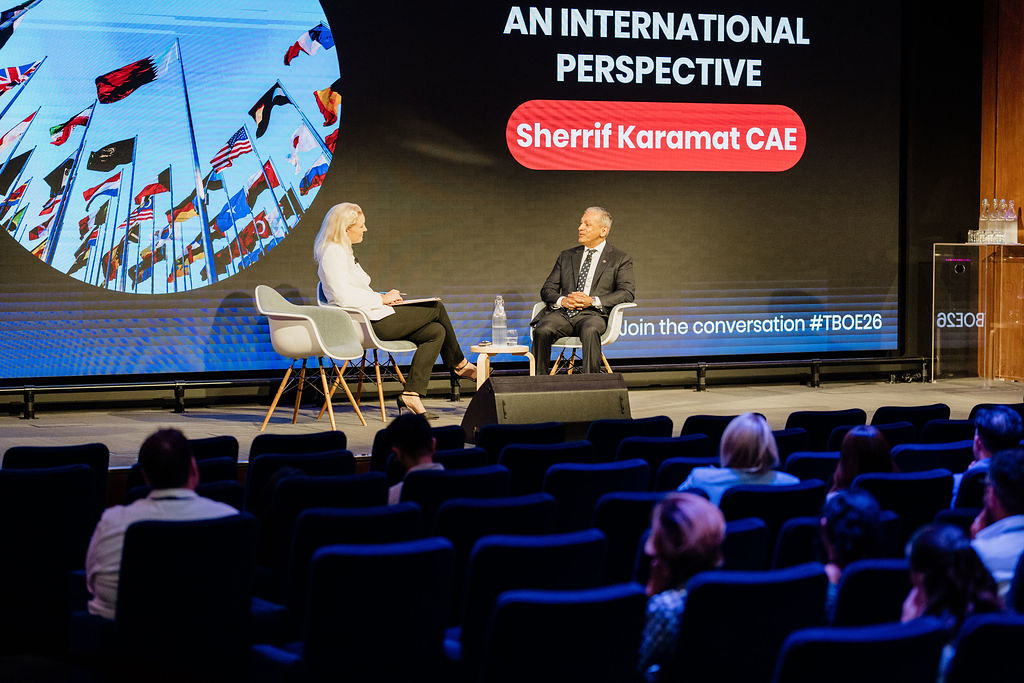
The UK business events sector must move beyond asking for recognition and start telling a clearer, more compelling story about the outcomes it delivers if it wants to secure stronger government support.
That was the challenge set by Sherrif Karamat, president and CEO of PCMA and CEMA, during The Business of Events Policy Forum on 7th July, as the industry reflected on the new Culture, Media and Sport Committee report into business events.
The report, published a day earlier, criticised the government’s lack of long-term strategy and support for the UK’s £33bn business events sector, warning that the country risks falling behind international competitors without stronger leadership, coordination and investment.
But while Karamat acknowledged that the UK is operating from a position of strength, he also delivered a frank international perspective on where the sector is falling short.
“You are doing a lot right,” he said. “But you need to own that.”
He argued that the sector must be more confident about its strengths, clearer about what it wants from government, and more coordinated in how it presents its case.
Asked what the UK could learn from other markets, Karamat pointed to countries such as Canada and the US, where organisations including Meetings Mean Business have helped create clearer, more unified advocacy around the role and value of business events.
He said the UK sector needed to be more specific about what it wants to solve or achieve, whether that is funding, influence, recognition, or practical support.
“You all need to get it together and own what you are asking for,” he said. “I wasn’t sure what you were asking the member of parliament for earlier. If it’s money, what is it for? If it’s influence, what are you trying to achieve with that influence?”
His comments echoed an earlier session with Martin Rhodes MP, chair of the All-Party Parliamentary Group for Events, who urged the sector to identify “one, two, or three simple asks” and speak with a clearer collective voice.
Rhodes, who has become an increasingly vocal supporter of the sector since taking on the APPG role, said he shares the frustration that business events do not receive the same level of attention from policymakers as major sporting or cultural events, despite their economic and regional impact.
“What I hear about is a hugely successful sector doing a huge amount of work, delivering economic activity on a basis which is geographically spread around the country, and it just doesn’t get the sort of attention that, for instance, culture and sport get,” he said.
But he also argued that big numbers alone are not enough to cut through.
“There’s always a danger when you say so many billion pounds, or this is the impact, that those high figures are just big figures that don’t really cut through,” Rhodes said.
“I think you need the data undoubtedly to make the case, but it’s also about sharing those stories about the impact of the sector on the economy at a higher level, nationally and regionally, but also localised as well, and the impact that has on people’s lives and communities.”
Karamat took that argument further, suggesting that the sector often focuses too heavily on the “means to an end” rather than the wider outcomes business events create.
“What I’m talking about is the outcome that we have in greater society: creating jobs, start-ups, incubators, working with universities,” he said.
He cited major medical and scientific congresses as examples of events that can accelerate knowledge exchange, policy change and public health outcomes, rather than simply generating visitor spend.
“These stories cannot just be told in economic terms,” he said. “Business events use tourism assets, but we’re not part of the tourism initiative. We’re about driving economic and social outcomes in other sectors.”
Karamat also argued that the rise of AI and the erosion of trust in digital communications could create a major opportunity for face-to-face events, as people increasingly seek authentic human connection.
“The erosion of trust is giving greater rise to face-to-face events, so I actually see more and more events, and it’s a great opportunity for the UK,” he said.
He added that new areas of growth, from AI to medical science, are already driving demand for new conferences and communities around the world. But he warned that the UK needs to position itself more confidently if it wants to compete for that future pipeline.
“This is not about today. It is about future years,” he said. “If you’re not in the game, and you’re not able to be in the game, you will actually be suffering in 2035.”
The discussion followed calls in the CMS Committee report for a standalone national business events strategy, a sector-led National Business Events Council, sustained funding to promote the UK internationally, and stronger cross-government coordination.
Rhodes said there was a clear danger that other countries could move ahead if the UK fails to act.
Dame Caroline Dinenage DBE MP, chair of the Culture, Media and Sport Select Committee, also urged the sector to come together around a focused message as it awaits the government’s response to the report.
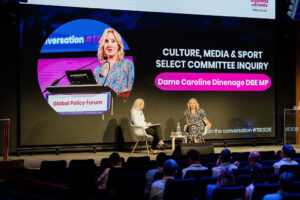
She said the committee’s recommendations offered “quite an easy pathway for the government to follow” that could “meaningfully change the dial” for business events but warned that the industry must keep making its case.
“It is the squeaky wheel that gets oiled,” she said. “You need to come together with a single ask or key message, and then you need to get that message out to as many MPs as possible.”
Dinenage reinforced one of the report’s central arguments: that business events should be treated as a driver of trade, growth and soft power, not simply as an extension of tourism. “This is business, and it’s serious business,” she said.
During the forum, concerns were also raised around the recent reduction in VisitBritain’s business events resource, the fragmented nature of government responsibility across multiple departments, and the need for stronger international promotion of the UK as a business events destination.
Karamat’s closing advice was that the sector does not necessarily need one single voice, but it does need one clear message.
“You can have multiple voices, but one message,” he said. “You are all saying the same things, but I don’t see a unified position.”
For an industry still digesting a landmark select committee report, the message from the forum was clear: government needs to act, but the sector must also sharpen its ask, speak with greater clarity and tell a stronger story about the impact business events deliver.