
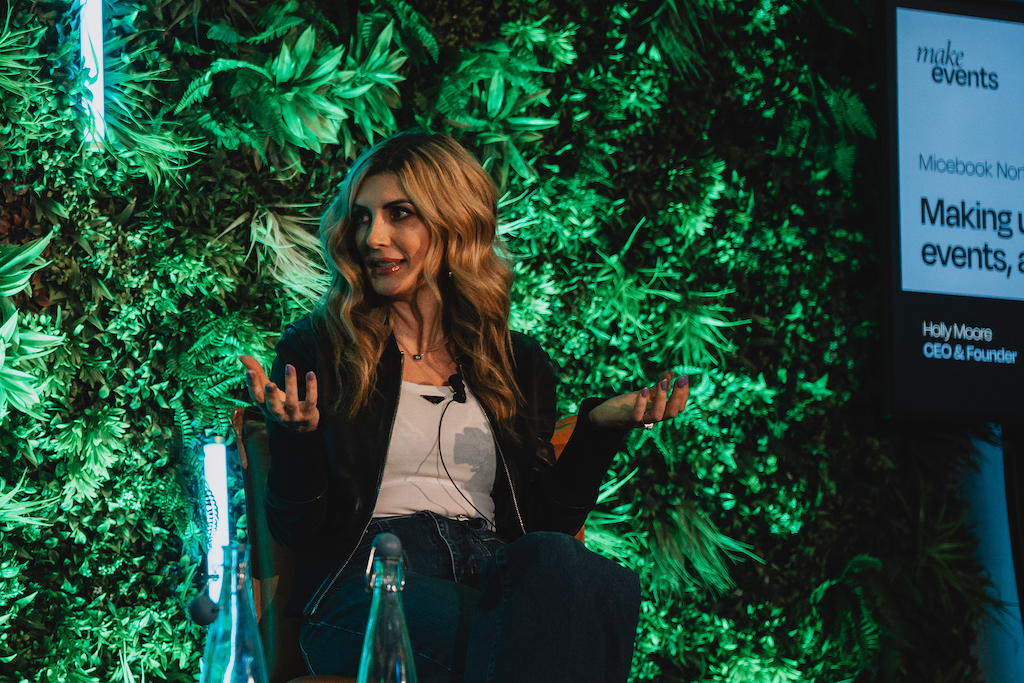
By Holly Moore, CEO & Founder, Make Events
At Micebook Northern Edition, I was asked to share some of the thinking behind our approach to delivering events in environments that don’t always feel like obvious event venues.
It’s something I’ve always been drawn to, not because unconventional spaces are more dramatic, but because they encourage a different kind of creative thinking. And in events, it’s often that shift in perspective that leads to the most memorable experiences.
Why unconventional spaces create emotional impact
There is something powerful about the moment guests arrive somewhere unexpected. They may know the location in advance, but when they step into a space and think “I didn’t expect this here”, their mindset shifts. They become more curious, more present and often more open to the experience that follows.
That emotional reset is incredibly valuable. It creates intrigue for consumer audiences and genuine excitement for employees or clients. It sets the tone before a single piece of content has been delivered. Over the years, I’ve seen how unconventional environments can turn events into shared moments of discovery, something that feels less transactional and more immersive.
Creativity thrives when the environment challenges you
Traditional venues are designed to make events easier. Unconventional environments often do the opposite. They come with infrastructure challenges, unusual layouts and operational realities that force teams to rethink everything, from guest flow and content delivery to atmosphere and storytelling. But that tension can become a powerful creative driver.
When we hosted the groundbreaking event for Nobu Manchester in an unused city-centre viaduct, the rawness of the space shaped the entire experience. It allowed us to play with contrast – layering refined hospitality, lighting and production design against an industrial backdrop. The result wasn’t just visually striking, it felt emotionally distinctive and true to the moment.
Similarly, delivering a gala inside a working railway museum for Hitachi meant designing around heritage structures and live operational considerations. Rather than limiting ambition, those parameters sharpened the thinking. Every creative decision had to work harder and feel more intentional.
This is often what constraints do, they create clarity. When everything is possible, it’s easy for experiences to become diluted. When options are tighter, teams are forced to prioritise what will genuinely create impact. Storytelling becomes more focused; design becomes more purposeful and collaboration becomes more important.
In my experience, this is what leads to experiences that feel truly distinctive, because they are shaped by real challenges, not theoretical possibilities.
It’s not about rejecting traditional venues
Working in unconventional spaces doesn’t mean conventional venues have less potential. Some of the most creative experiences can happen in ballrooms, conference centres and exhibition halls. The difference lies in how the space is used.
Creativity isn’t about rejecting traditional spaces; it’s about refusing to deliver traditional experiences. It’s about designing unexpected moments, creating layers of discovery and incorporating moments of magic throughout the guest journey.
That might mean reshaping arrival, so it feels cinematic rather than functional. Using lighting and production to completely reframe how a room is perceived. Creating contrast intimacy within scale, energy within structure.
Trust and collaboration make bold ideas possible
Delivering ambitious experiences in unexpected environments requires trust – between clients, teams and suppliers.
Clients are often investing in ideas that have no direct precedent and suppliers are being asked to help create solutions that don’t exist yet. Teams are balancing creative ambition with operational reality. When relationships are strong, those conversations become energising rather than risky.
Bold thinking becomes possible because everyone understands the shared goal: creating something meaningful, memorable and genuinely different.
Rethinking what makes an experience unforgettable
In a crowded experiential landscape, scale alone is no longer enough. Audiences are looking for authenticity, emotion and a sense of discovery. Unconventional spaces can help unlock that, not because they are unusual for the sake of it, but because they encourage us to rethink how events are designed and delivered.
When creativity is shaped by environment, grounded in purpose and supported by meticulous planning, almost any space can become an extraordinary stage. And often, it is the spaces that initially feel the most challenging that lead to the most powerful outcomes.