
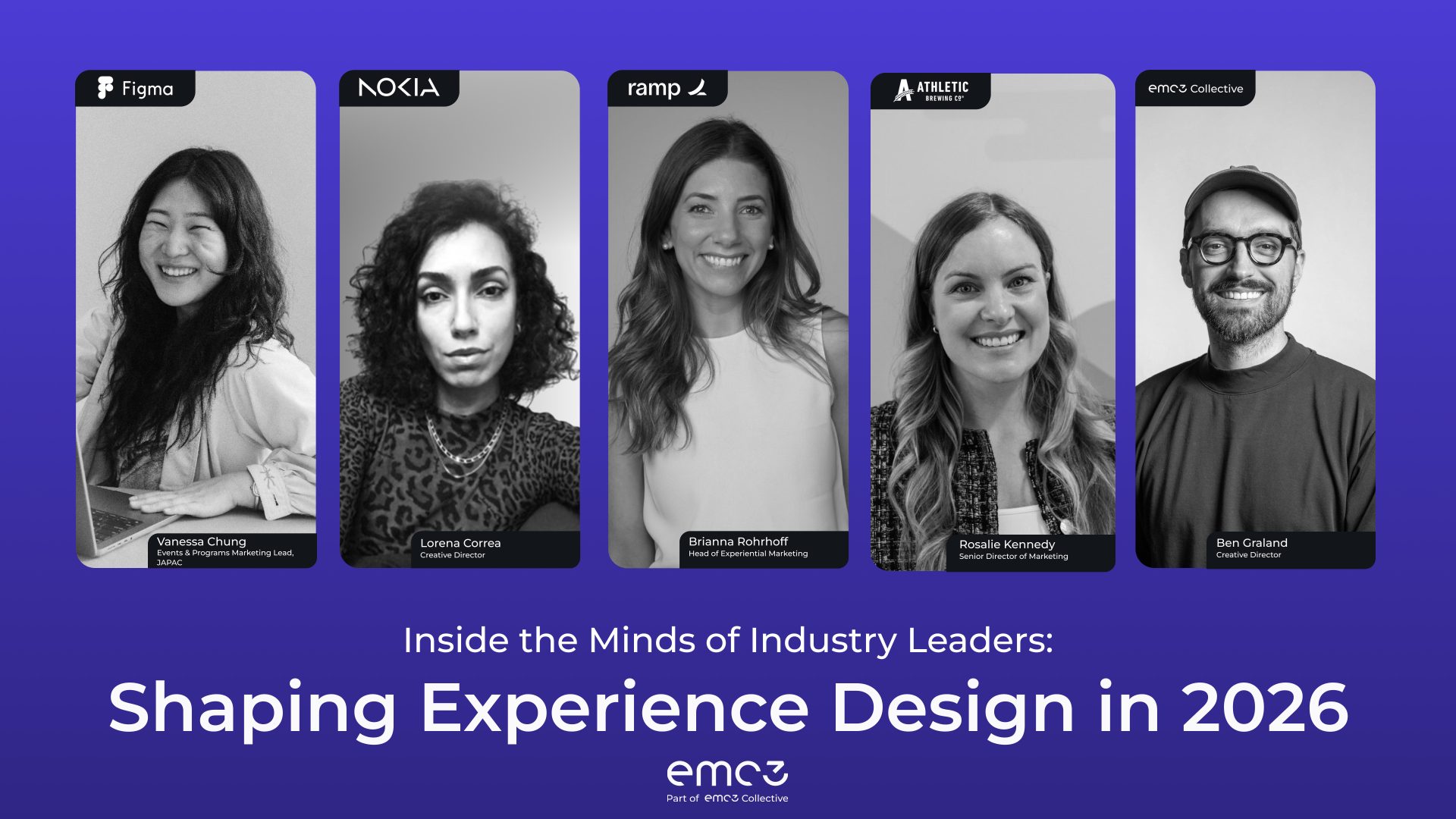
Industry leaders from Figma, Nokia, Ramp, Athletic Brewing Company and emc3 Collective share their views on the creative decisions that matter the most. A clear theme emerged: great experience design isn’t just about doing more, but about knowing what to prioritise.
The most memorable moments aren’t always the defined by scale, but how they’re orchestrated – how people move, connect and what stays with them.
Vanessa Yuri Chung, Events & Programs Marketing Lead, JAPAC, FIGMA
What’s a creative decision in events that matters more than people realise?
Transitions! What happens after attendees pick up their badges and before the keynote begins? What are you playing on screens as people sit down for your first session? What are people engaging with during breaks between sessions? Making the ambient spaces more meaningful and thinking through what happens between the headline moments reveals how the experience was designed; a bad transition can break the vibe faster than a bad speaker.
Events are shared experiences – but audiences experience them individually. How do you design for both at the same time?
We know people join us for different reasons; to hear from industry leaders, meet other product builders, or to pick up some Figma swag. As a collaborative platform, we design for the collective moments first, and then leave room for attendees to find their own version of the day.
The anchors that everyone moves through makes our attendees feel that they’re a part of something bigger. Once that’s established, we build the individual experiences as the moments attendees remember.
What real-world factor challenges a creative idea the most?
Localisation. Running a roadshow across Tokyo, Seoul, Singapore, and Sydney means thinking through how content, experiential, and promotion can land differently in each region. Through thinking more globally (our Director of International Marketing sent us a copy of The Culture Map several years ago), we’ve developed a muscle to design with a strong central concept and deliberate flex points; enough consistency that it feels like a cohesive program, but enough room that each city feels like the event was made for them.
How do you measure if the creative actually worked?
Read the room (which sometimes means that I ignore the survey results). Are we having to extend our venue contract time because people aren’t leaving? Did the audience photograph a particular moment in the content or experience that we didn’t expect? Did our MC go off-script because the energy felt right? Those are my signs. The numbers can show how we did with logistics, but the behaviour tells me if the experience landed.
Finish this sentence:
An event becomes memorable when… people are already asking when we’ll be hosting the next one.
Lorena Correa, Creative Director, Nokia
What’s a creative decision in events that matters more than people realise?
Defining a single narrative early is often underestimated. In complex environments, teams tend to want to promote their own stories, timelines, and priorities. Without strong alignment, this leads to a fragmented experience. Establishing a clear narrative from the start ensures teams connect their contributions, allowing the audience to experience a cohesive brand story instead of disconnected demos and messages.
Events are shared experiences – but audiences experience them individually. How do you design for both at the same time?
Utilising social media, websites and other touchpoints, before the event, help audiences understand what the brand is about and why it matters to them. That same narrative needs to carry into the event, where it should be clear at a glance, so everyone shares a common understanding – while still allowing for different levels of engagement, from high-level experiences to more technical, in-depth ones. After the event, continuing that narrative across the same touchpoints keeps people connected, so each person can engage with it at their own pace and depth.
What real-world factor challenges a creative idea the most?
Budget and space are constant constraints, but the real challenge is prioritisation. Not everything can be a hero. Creative direction becomes a series of decisions about what deserves visibility, what can be simplified, and what needs to be removed entirely. Strong ideas are not just about creativity, but about making clear choices that protect the core experience while adapting to the practical limitations.
How do you measure if the creative actually worked?
You can see it in the audience behaviour. Are people stopping, staying longer than expected, and engaging without being prompted? Are they asking specific questions or able to explain the idea back in their own words? Follow-up meetings matter, but what happens in the moment is often more telling. If the experience creates clarity and curiosity at the same time, it’s working.
Finish this sentence:
An event becomes memorable when… it’s a moment in a longer aligned narrative, and not a standalone experience.
Brianna Rohrhoff, Head of Experiential Marketing, Ramp
What’s a creative decision in events that matters more than people realise?
The arrival experience. Events can be won or lost in the first five minutes: before the keynote, before the dinner, as guests walk into the room. I produced an après-ski themed after party for a 3,000+ person conference, and the moment guests entered, their phones came out. Not because we asked, but because they couldn’t resist capturing it. The first impression sets the emotional baseline for everything that follows, and getting it right is the creative decision that quietly shapes everything else.
Events are shared experiences – but audiences experience them individually. How do you design for both at the same time?
You design the collective arc, but you engineer the individual moments within it. A large conference needs to unite thousands of people around a shared energy, but inside that room, people might be there for completely different reasons. The answer is layering: a powerful shared narrative on the main stage, and then the small, considered details underneath it (a personalised touch, a curated conversation, a seat next to exactly the right person) that make individuals feel seen inside the larger whole.
What real-world factor challenges a creative idea the most?
Stakeholder alignment, or the lack of it. I’ve watched genuinely stunning creative concepts get stripped to something unrecognisable because teams couldn’t agree on what the event was for. The most important creative discipline isn’t conceiving the idea; it’s building enough shared vision, early enough, that the idea survives contact with reality. Events sit at the intersection of so many competing priorities. The ones that land creatively are almost always the ones where alignment happened before the brief, not after.
How do you measure if the creative actually worked?
You look for the unscripted moments. Did people linger longer than the agenda called for? Did someone track you down afterward to say something specific (not just “great event”) about the experience? Those are the signals I trust most. I also look at downstream behaviour: did a relationship deepen, did a conversation start that wouldn’t have happened otherwise? Creativity works when it moves people emotionally, and people who are genuinely moved take action. That’s the only measurement that really matters.
Finish this sentence:
An event becomes memorable when… a single, deeply thoughtful gesture makes every guest feel like
Rosalie Kennedy, Senior Director of Marketing, Athletic Brewing Company
What’s a creative decision in events that matters more than people realise?
Defining the role your brand plays in the moment. It’s tempting to over-communicate brand messages but choosing to lead with the experience shapes everything. When the brand enhances the moment instead of interrupting it, it feels natural and far more memorable.
Events are shared experiences – but audiences experience them individually. How do you design for both at the same time?
Great events succeed when shared energy and personal relevance coexist. Start with the “why.” Most people come to an event to connect, so design spaces that naturally encourage social interaction: flow, gathering points, and low-friction engagement. At the same time, layer in clear, memorable individual touchpoints: personalised moments, and brand messages that stick. For Athletic Brewing Company, that means enabling fun, social drinking experiences while ensuring each guest leaves with a distinct understanding of the brand.
What real-world factor challenges a creative idea the most?
Budget is often the biggest real-world constraint. The most inspiring ideas can be costly, and it’s not always feasible to justify that spend. But constraints sharpen creativity. They force you to prioritise what truly matters and find smarter, more resourceful ways to execute. Being transparent about budget early on allows teams to align on impact versus cost, often leading to ideas that are not only more efficient but also more inventive and strategically focused.
How do you measure if the creative actually worked?
You can measure success by how people actually behave. Are they stopping, engaging, and spending time with the experience? Is the energy natural and social, or forced? Qualitative observation on-site is invaluable e.g. watch what draws people in, what they remember, and how they interact. If people leave with a clear impression of the brand and a positive memory, the creative worked.
Finish this sentence:
An event becomes memorable when… you get someone coming back with a friend in tow!
Ben Graland, Creative Director, emc3 Collective
What’s a creative decision in events that matters more than people realise?
I always come back to one principle: immersion. Every detail, from the space and graphics to sound and messaging, should reinforce what people are part of, enveloping them in the experience. When those cues are consistent, guests feel anchored – they relax, engage, and are open to explore.
Immersion reduces friction. People aren’t second-guessing or searching for direction, they’re fully present. It’s a subtle safety net that turns anxiety into curiosity, and confusion into a sense of adventure.
Events are shared experiences – but audiences experience them individually. How do you design for both at the same time?
Start by really understanding who’s in the room: why they’re there, what they need, and how they like to engage. Then build the experience like Matryoshka dolls, one big story with smaller, optional layers inside it. Under a single event theme, you create side moments, pockets, and paths for different types of people. Some might want intimacy, others spectacle. The art is to briefly disrupt their expectations without breaking the overall flow, so everyone feels both included and personally seen.
What real-world factor challenges a creative idea the most?
We like to say constraints make us more creative… and often they do. Budgets, audience behaviour, space, and timelines force sharper thinking and smarter choices. But the truth is, budget is still the biggest tension point. You’re always negotiating between ambition and reality. On top of that, accessibility, social and environmental sustainability are now non‑negotiables. If you ignore them, the experience might look impressive, but it won’t feel right, and in 2026, that’s the fastest way to make an event forgettable.
How do you measure if the creative actually worked?
For me, success is shared. You feel it in the team, the client, and the room. It’s in the moments when feedback is great, but you also feel genuinely proud because the idea survived all the compromises. Creative work is like a puzzle: when the right pieces stay in, everything suddenly clicks for everyone. The best feeling is spotting a spark early, fighting to protect it, and seeing it live exactly as you imagined. That’s when you know: we didn’t just deliver an event (mic drop), we delivered our vision.
Finish this sentence:
An event becomes memorable when… it feels like one big, shared story, but everyone walks away with their own plot twist. It’s familiar enough to feel safe, bold enough to be surprising, and resilient enough to survive budgets and logistics without losing that original spark.
Across these conversations, a few themes came up again and again: the importance of clarity over clutter, with a strong narrative that holds everything together; and the need to design not just for the headline moments, but for transitions, arrival points, and the quieter details that shape how an experience feels in real time.
What unites every perspective is the idea that memorable events are built through intention. Not by doing more for the sake of it, but by understanding what matters most, protecting the core idea and making every decision work harder. Whether that shows up in the way people move through a space, the way a story carries across touchpoints, or the way guests respond without being prompted, the strongest experience design in 2026 will come from creativity that is both considered and clear.
This article was created by emc3 Collective