
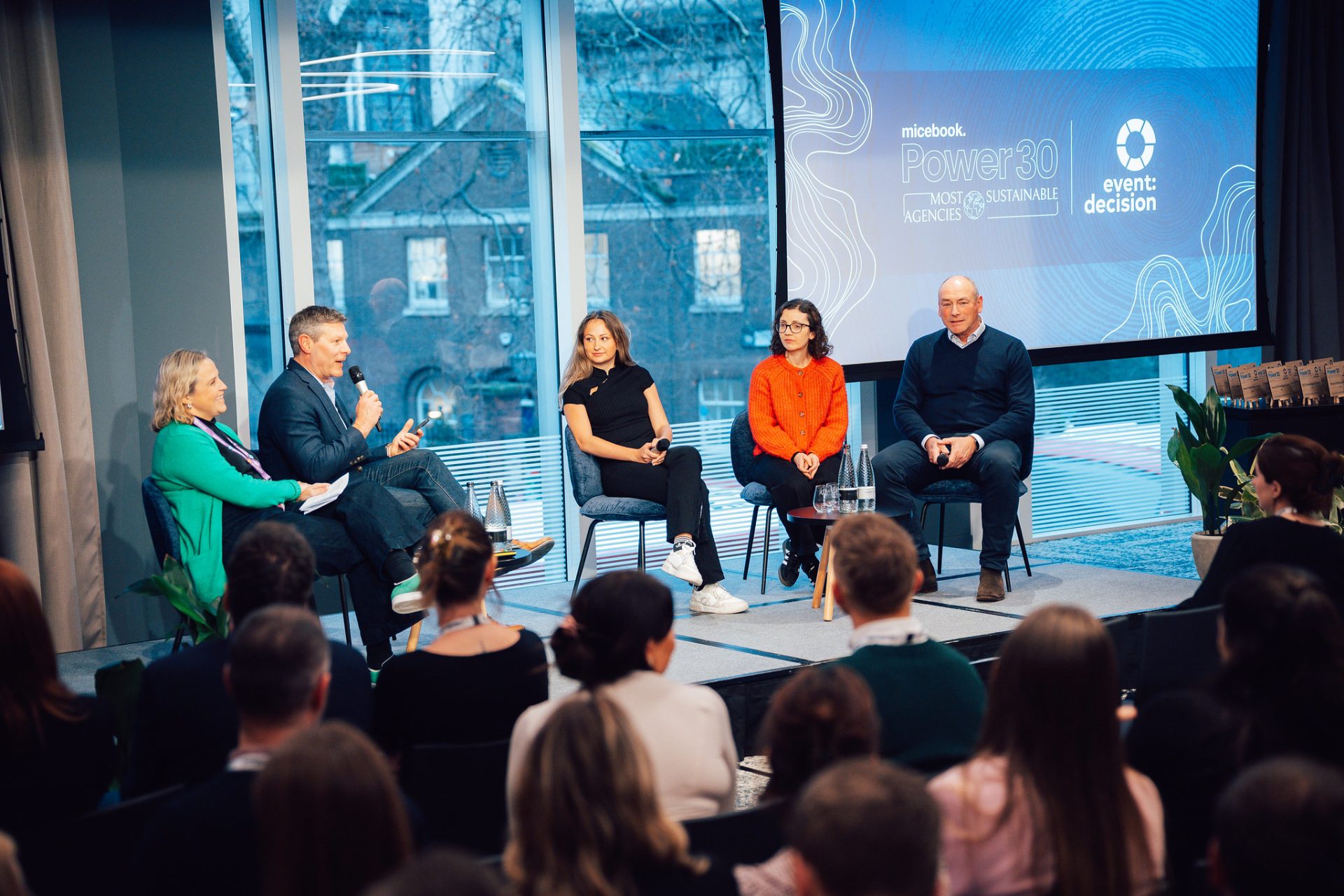
The launch of the Power 30 Most Sustainable Agencies at micebook EXPO brought together agency leaders for a practical discussion about the state of sustainability in the events sector today.
Created in partnership with event:decision, the Power 30 recognises the agencies leading the way on ESG, and this year, we handed out three special awards – to emc3 as Best Performing Agency overall, SLX as the Highest New Entry, and Broadsword as the Biggest Climber.
Broadsword’s Anna Green, emc3’s Matilda Riley and Alastair Currie from SLX, joined us on stage to share what is driving results and how they handle the realities of client pressure, budgets and delivery. The discussion focused on three questions: what makes them successful, how they handle client pushback, and how they measure real impact.
Here’s some of the key takeaways…
1. Embed sustainability across the business, not in one role
At emc3, Matilda Riley said the biggest driver of success has been translating sustainability into commercial value for everyone in the agency.
“You’ll have a sustainability lead; they’ll create a report at the end. But it’s the account managers, the ADs, the project leads who are having that interaction with the client. If you’re just sending a report in an email afterwards with no explanation, it doesn’t mean anything,” she said.
“It’s about business sense. As an AM, you can upsell this. Marketing can use it. Project leads can swap materials.”
2. Use B Corp as a cultural anchor, not just a badge
Both Broadsword and SLX spoke about the role B Corp has played in shaping behaviour. For Anna Green at Broadsword, B Corp provided a clear framework and accountability.
“It became a useful anchor and symbol for the team. Once you become B Corp, you’re legally accountable to those standards. It showed us it was more than carbon reporting or reducing waste. It’s the full spectrum of how you run an ethics-led business.”
She also emphasised leadership integrity. “If you say you want to run a sustainable agency, then live it. Don’t do something behind the scenes that clashes with that.”
SLX echoed this, describing how becoming B Corp helped reset priorities from grassroots to board level. “It gave us a clear way of thinking about how we engage with our people and our clients,” said Currie. “As a technical supplier, we can show agencies how choices around power, lighting, sets and materials actually add value to projects.”
3. Make sustainability the default, not an optional extra
All three agencies described a move from opt-in to opt-out. At Broadsword, carbon reporting now appears on every quote. “There’s a conversation where it has to be removed rather than added on,” Green explained. “Clients do push back, but we keep talking about it. Don’t give up.”
EMC3 has gone further, with sustainability consultants now embedded on every project. “We used to offer it as optional. Now it’s non-negotiable,” added Riley. “As a B Corp, this is our ethos. You chose to work with us.”
Crucially, emc3 also reframes sustainability in the client’s own language. “It’s not about saying you saved 20 tonnes of carbon. It’s linking choices to their CSR goals, ESG reporting and Scope 1, 2 and 3. Suddenly it clicks.”
A recurring theme was that social value often unlocks client buy-in more effectively than carbon alone.
Turning intention into action: how impact is measured
Each agency described different structured examples of making sustainability repeatable.
SLX: event-level impact reports
SLX produces an impact report for every event, covering travel, fuel, waste and power usage.
“This lets us go back to clients year on year and say, what can we improve from last time?” said Currie. “Battery power overnight instead of diesel. No PVC tape. Fewer cable ties. All these little things make a massive difference.”
emc3: five-pillar reporting
The agency reports on five pillars for every event: environmental, accessibility, DEI, wellbeing and community.
They find social and community stories often resonate more than carbon metrics.
“If you tell someone you redistributed £10,000 of furniture to families in East London, that sticks,” Riley said. “You can’t forget that in the same way as ‘X tonnes of carbon saved’.”
Broadsword: supplier KPIs
Broadsword introduced a supplier classification system and business-wide KPIs to increase use of sustainable partners across the UK and APAC.
They are now seeing measurable growth in sustainable supplier usage, reinforced by internal training events with social enterprises such as Clean Break and Luminary Bakery, which staff now actively recommend to clients.
These insights from Broadsword, EMC3 and SLX are just a snapshot of what’s happening across the Power 30. Together, they reflect a wider shift among leading agencies: embedding sustainability into everyday decision-making, strengthening ESG performance, and turning responsible delivery into a genuine business asset rather than a bolt-on.
Read the full Power 30 publication here to explore the complete findings, agency profiles and benchmarking insights.