
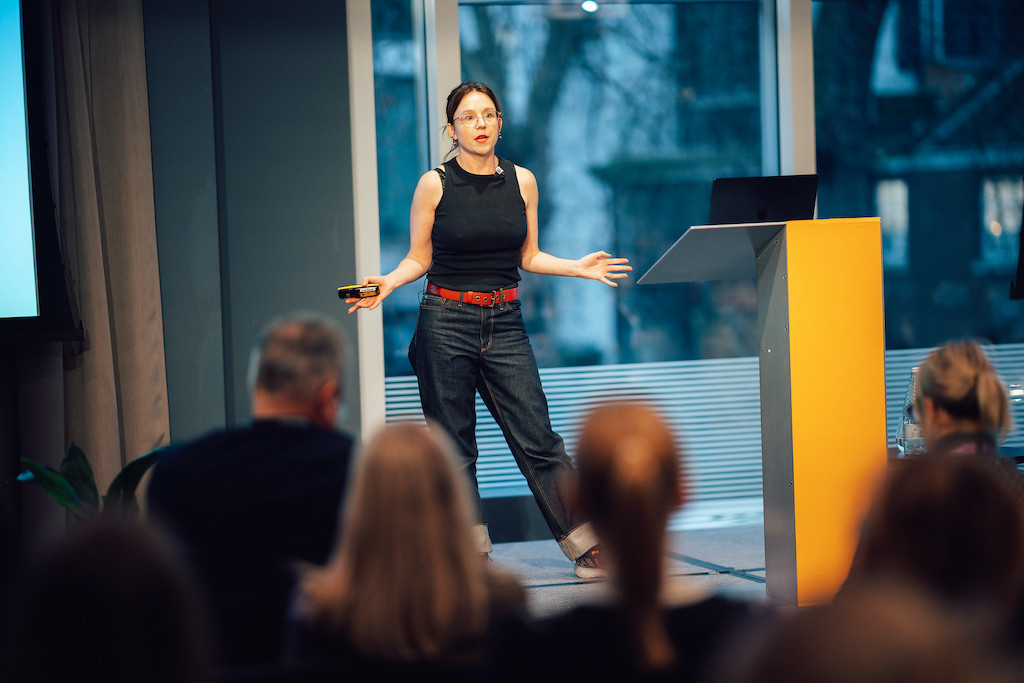
At micebook EXPO, co-founder of digital agency Lookout Studio Gemma Screen shared insights on how event managers can use AI as a thinking partner, not a shortcut. To deepen ideas and sharpen creativity.
In her session, Beyond Average: Using AI to Create Better Events, Screen framed AI as a tool to remove friction so creative teams can do their best work. “Your opportunity, your differentiator in today’s world, doesn’t lie in efficiency and execution, it lies in your creativity.”
Referencing recent research into associative thinking, Screen explained how machines can already outperform humans on early creative tasks. But when researchers compared AI with the most creative people, humans pulled ahead.
“When they compared against the top 50% of creative thinkers, humans outperformed every time. And that gap got wider and wider. For the top 10% of creative humans, that gap was significant.”
She warned that AI makes it incredibly easy to become creatively average. “Most people are going to use AI to get to average and stop because it’s easy. But that’s a dangerous game to play.”
The real opportunity, she said, is learning how to use AI to get to average quickly, and then keep going.
Intentional AI: knowing when to go fast and when to slow down
A recurring theme throughout Screen’s session was intentionality. She encouraged delegates to be deliberate about where AI should speed things up, such as drafting, formatting and admin, and where humans should slow things down, including brainstorming, judgment and emotional connection.
“Fast is only going to get you to average, really fast.”
Creative thinking, she reminded the room, does not always happen at desks. “Sometimes that work doesn’t even happen at our desks. It happens when we’re walking or driving or doing washing up.”
Screen also highlighted areas where AI simply does not belong, from building rapport in a room to creating psychological safety. “Notes which are clearly written by AI don’t make people feel good.”
And she gave permission to keep the parts of the job people love. “Those are the things that you want to take your sweet time over. Even if AI can do them, you’re allowed to still go slow.”
AI as “the intern with a PhD in everything”
Screen shared an analogy from Dharmesh Shah of HubSpot, who describes AI as “the intern with a PhD in everything”. Smart and keen, but useless without onboarding.
Just like a new team member, AI needs context about your business, your preferences, your processes and your priorities. Without that structure, Screen warned, you end up spending more time going back and forth with AI than if you had just done the task yourself.
Her advice was to invest early in personalisation, whether through ChatGPT projects, custom GPTs or workspace tools like Notion or Copilot, so AI understands how you work.
Done properly, this unlocks meaningful efficiencies, from turning meeting notes into project plans, to building budgets from templates, to researching speakers against defined criteria.
“My time isn’t spent doing the nought to average bit. My time is spent doing the average to excellent bit.”
From wide to deep: using AI as a creative thinking partner
Screen described two modes of AI use: wide and deep. Wide is about speed and efficiency: drafting, admin and repeatable tasks. Deep is about exploration: brainstorming, combining abstract ideas and pushing concepts further.
If you only ever operate in “wide”, she said, you stay stuck at average. The real value comes when you use that saved time to go deeper.
To help delegates do this, Screen shared a four-part framework for creative prompting:
- Set the scene with rich context about your audience and goals
- Role play, asking AI to think like inspiring figures such as Larry Harvey or hospitality expert Will Guidara
- Be specific about what you want and why
- Add constraints around time, budget, location and accessibility
Used well, AI becomes a thinking partner that helps planners design moments that feel more connected, more meaningful and more human.
Designing experiences that matter
Throughout the session, Screen repeatedly brought the focus back to people in the room. Yes, AI can help analyse inboxes, generate FAQs or build concierge tools for speakers and attendees. But connection still belongs to humans.
She encouraged agencies and organisers to use AI to remove friction, so they can spend more time creating experiences that spark emotion and memory.
Her closing slide showed a small gathering in West Wales, intimate and deeply moving. “Right now, the world needs more events like this that make people feel alive and connected and inspired,” she said, adding “the people with the creative skills to deliver them are the people sat in this room today.”