
By Susie Harwood
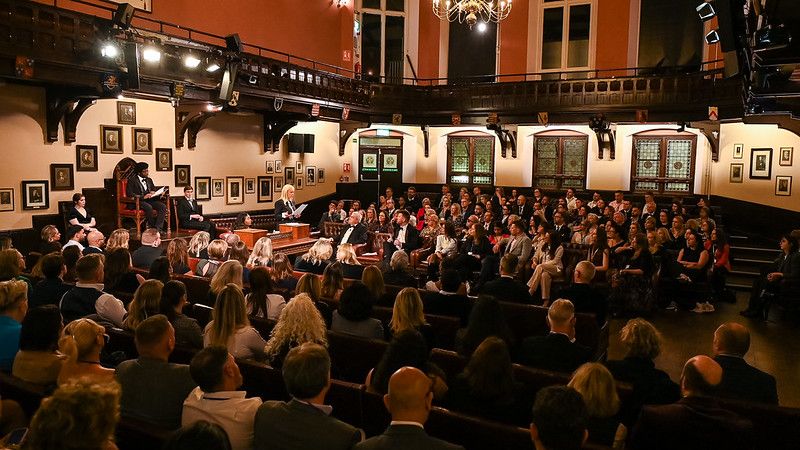
Last week, in collaboration with the Cambridge Union Society, the Alliance of Independent Event Agencies (AIEA) brought the Industry Great Debate back for its fourth edition in the historic Cambridge Union Chamber.
The motion was deliberately provocative: “This house believes the integrity of familiarisation trips is being compromised.” It certainly got a reaction, not just from the speakers, but from the floor. From hotels and agencies to representation companies and DMCs, every part of the industry was represented, and the number of hands raised to interject proved just how hot this topic was.
The nays won the vote, 108 to 80, with 6 abstentions, but the outcome didn’t feel like a neat verdict of “all is well”.
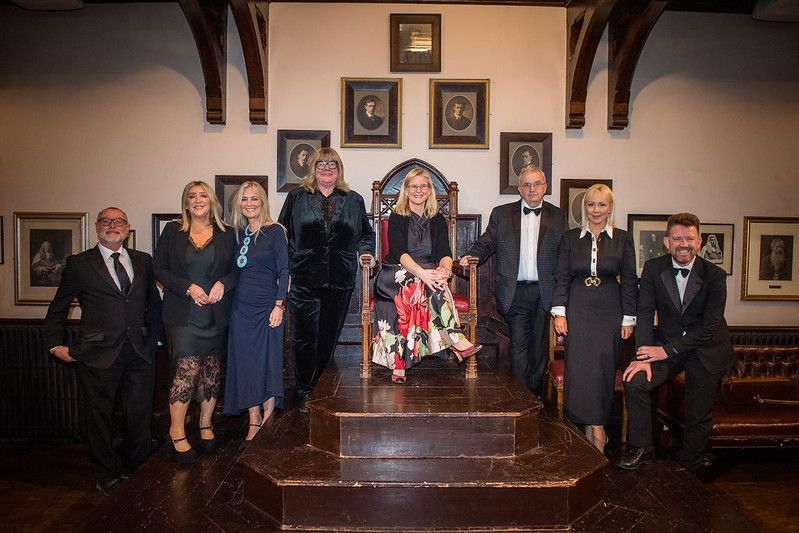
Katie Niland (The Belfry Hotel & Resort), Chris Clarke (Purple Dog Solutions and Leadership West), and Catherine Chaulet (Global DMC Partners) argued for the motion. Andrew Woods (Leonardo Hotels), Peter Jackson (Red Blaze Trust), and Emma Waycot (Vine Tree Connections) opposed it. All gave compelling arguments. I found myself changing my mind throughout the night after each speaker and, in truth, largely sitting on the fence by the end.
What struck me most is that no speaker, not even those arguing for the motion, suggested that familiarisation trips are anything other than a fundamental tool for our sector. Chris Clarke put it plainly: “I’m not anti the familiarisation trip… at their best, [they] are the most powerful tools our industry has.”
FAMs, or whatever we call them, are how we build confidence, knowledge, relationships, and ultimately business. They reduce risk for buyers and accelerate decision-making. They help suppliers show, not tell, their story. At their best, they are one of the most effective forms of business development our industry has.
The debate did, however, raise questions around what a FAM actually is, what we expect it to be, and what happens when the line blurs between professional development, business development, and perceived perk.
The opposition: integrity is why FAMs work at all
On the opposition side, the argument was essentially this: if FAMs didn’t have integrity, no one would invest the time and money in them. Questioning their integrity risks sounding like we’re questioning the integrity of the people who run them, and the people who attend them, which is why “integrity” quickly became a loaded word. Andrew Woods challenged the implication behind the motion: “The suggestion that my fellow suppliers and I will lie… is frankly offensive.”
Emma Waycot captured the emotional charge of the motion when she said: “I take this motion very personally because I know just how much hard work, care and responsibility goes into delivering a successful FAM trip.” She also challenged the “free holiday” framing head-on: “A FAM trip is not a free holiday. It’s not a free lunch.”
The opposition spoke in detail about the lengths suppliers and agencies go to qualify the right individuals, and the ROI that comes when trips are targeted and purposeful. Emma made the uncomfortable point that over 80 buyers in the Cambridge chamber were being hosted at the event. As she put it, “They are on a FAM trip right now.”
She also made a softer but important point. Beyond the educational value, these trips build friendships and relationships that sit at the heart of how our industry works. That relationship capital is often part of the return, even if it is hard to measure.
Peter Jackson took a longer view on return. For him, the real output of a good trip is trust, and the commercial payoff does not always show up quickly. He shared that one invitation took nearly four years to turn into a tangible opportunity, a reminder that not all ROI is immediate.
The proposition: the model is creaking without standards
On the proposition side, the argument wasn’t anti-FAM. It was a warning that the model is creaking in places, and that familiarisation trips can lose their way without guardrails.
Katie Niland’s contribution landed because it was both supportive of the concept and honest about the drift. “Let’s be clear from the outset, I am not anti-[FAM]. I believe in them. I host them,” she said, before adding that she has also been complicit in what they have become. “Somewhere along the way, the professional site visit quietly morphed into a very pleasant mini break, and we all just went along with it.”
Where the proposition succeeded was in articulating what so many people mutter privately but hesitate to say publicly. The same people can attend repeatedly, “place fillers” can replace relevance, and some buyers can take liberties with schedules, expectations, and professionalism. Turning up late, dipping in and out, cancelling last minute, or only attending the “good bits” undermines the very investment suppliers are making.
Then there is the question of optics, particularly online. Chris Clarke called out what those optics can imply when participants are posting cocktails, pools and sunsets, “reinforcing the idea this industry is one big jolly.” After all, if we want to be seen as strategic partners, we should be mindful of how we present ourselves when hosted experiences are involved.
Clarke reframed the issue as one of purpose, not policing and offered a clear definition of what a FAM is meant to do: “A FAM trip exists to educate… through inclusion in real proposals for real business. That’s the social contract.” He challenged the mindset that can creep in when hosting becomes expected rather than earned: “Education, not entitlement, is the foundation.”
He also pointed to how often learning stays with the individual, rather than being shared back with the wider team, meaning the benefit of the trip is not cascaded across the business in the way it should be. It raises a fair question: should hosts start expecting, or even requiring, some proof that the learning has been shared, whether that is a short internal debrief, a written report, or takeaways circulated to the wider team?
Catherine Chaulet brought the ROI lens into sharp focus, especially from a DMC perspective where costs are real and margins can be tight. Her challenge was simple: too often there are “absolutely no metrics” attached to these trips and “no obligation” for attendees to deliver anything afterwards.
My takeaway: FAMs are vital, but they can and should be improved
I left feeling the debate was less about condemnation and more about calibration. The integrity of familiarisation trips has not collapsed, but the lack of shared standards leaves too much room for drift. Clearer definitions, sharper intent, better qualification, and explicit expectations could make a huge difference.
FAMs still matter. They remain one of the most powerful tools in our industry. Protecting the purpose is how we protect their credibility and, ultimately, their integrity.
The vote went to the nays, but the debate did not feel like a defence of the status quo. It felt like an industry having a grown-up conversation about a tool we all rely on. If a FAM is a privilege with a purpose, then it deserves purpose-led standards or a universally agreed upon code of conduct. Not to police people, but to make the exchange clearer, fairer, and sustainable for everyone investing in it.