
Across the events industry, conversations keep circling back to three themes: value, trust, and relevance. Attendees are asking whether your conference is still worth their time and budget. Sponsors are interrogating every line item. Boards are looking at events – often the most visible part of your brand and asking for proof, not promises. At the same time, AI can generate content at scale, misinformation travels faster than corrections, and audiences are learning to question almost everything they see online. In this low trust environment, events either become your most credible channel or an expensive habit that is hard to defend.
The trust gap for event professionals
Three pressures are converging on planners and marketers. Audiences are more digital first, budget constrained, and selective; registration is no longer automatic because people can access free content, communities, and professional development elsewhere. Sponsors are under pressure to justify every spend and increasingly compare your event to digital programmes that offer granular attribution and outcome based pricing. Meanwhile, leaders see rising delivery costs and ask which events genuinely move the needle on revenue, advocacy, pipeline, or member value and which exist mainly because “we’ve always run it”. Internally, events lose trust when their impact cannot be clearly explained.
Why does human connection still cut through
In an AI saturated world, reach is cheap – but credibility is scarce. You can buy impressions; you cannot buy belief. Trust starts from a simple idea: experience builds belief. Trust is built through human connection and lived experience, not just messaging. It grows when people can look someone in the eye and ask “why?”, hear honest, imperfect stories from peers, see leaders respond in real time, and test whether actions match rhetoric. When people talk about the best events they’ve attended, they mention the relationships they formed, the moment a session unlocked a complex problem, or the feeling of truly being represented in the room. All of these are trust signals: “I belong here”, “this organisation understands my world”, “they are genuinely on my side”. That kind of trust is almost impossible to fake in a feed but it is exactly what in person experiences are built to create.
Designing events with trust as the brief
If events are where trust is rebuilt, they must be designed with trust at the centre not as a happy side effect. That starts with changing the first question:
• From “What do we want to say?”
• To “What do our attendees need to understand, decide, or solve right now?”
Ask registrants upfront about their top questions and worries, then build the programme around those themes – not just internal messages – and be explicit in your copy: “This session exists to help you with X.” When people recognise their own challenges in the agenda, they arrive more engaged and leave more confident in your organisation, your community, and their decision to invest in your event.
Use intimate formats to earn deeper trust
Big plenaries give you scale; smaller formats give you depth. Inside your flagship experiences, intentionally create spaces that reduce the distance between your organisation and your audience:
• Roundtables and peer circles grouped by role, region, or challenge
• Short, focused clinics with experts, product specialists, or policy leads
• Attendee led discussions proposed and hosted by participants themselves
These formats turn spectators into participants, spark honest conversations you can feed back into your content and product strategy, and send a clear signal: “You can trust us – we’re here to listen, not just present.” This is trust through human connection in action: the moment where experience builds belief, and your event earns the kind of confidence no slide alone can deliver.
Making trust tangible for sponsors and boards
Trust also has a commercial dimension. For sponsors and boards, the real question is: “Can we trust this event to deliver what we need – and can we show that to others?” A practical answer combines ROI (Return on Investment) and ROE (Return on Experience/Engagement).
With sponsors, co create a plan that defines who they want to reach, what they need to influence (perception, pipeline, partnerships, recruitment), and the permission based encounters your event can enable – from hosted sessions to curated introductions and follow up content. Then agree a small, meaningful set of measures: qualified conversations, leads that meet shared criteria, follow up meetings booked, demos requested, trials started, and shifts in awareness or favourability among attendees. You are no longer selling packages; you are designing trust building experiences together.
For leaders, offer a clear four part view of impact: financial ROI (net contribution, pipeline influenced), engagement ROE (depth of participation, app adoption, session attendance), strategic influence (policy or partnership outcomes), and capability and insight (data and content created, skills developed in the team). Over time, the narrative shifts from “the conference felt good” to “this year’s conference generated £X net contribution, Y high value sponsor meetings, a Z point uplift in attendee confidence, and three new strategic partnerships”. That clarity builds internal trust and makes it much harder to treat events as mere cost centres.
Tech backstage, humans front stage
No discussion of events in 2026 is complete without AI. Used carelessly, it can make experiences feel less human; used well, it can free your teams to focus on the interactions that actually build trust. A simple principle helps: tech backstage, humans front stage.
Let AI and automation handle complex registration workflows, personalised communications, smart check in and badge scanning, stitching together engagement data, and turning live sessions into reusable clips and on demand content. Then put humans where only humans can shine: designing formats that encourage honest conversation, hosting rooms and noticing who’s quiet, responding in the moment when people raise difficult questions, and nurturing relationships that last well beyond the closing keynote. In that model, technology does not replace trust building; it enables it.
Where Cvent fits in the trust story
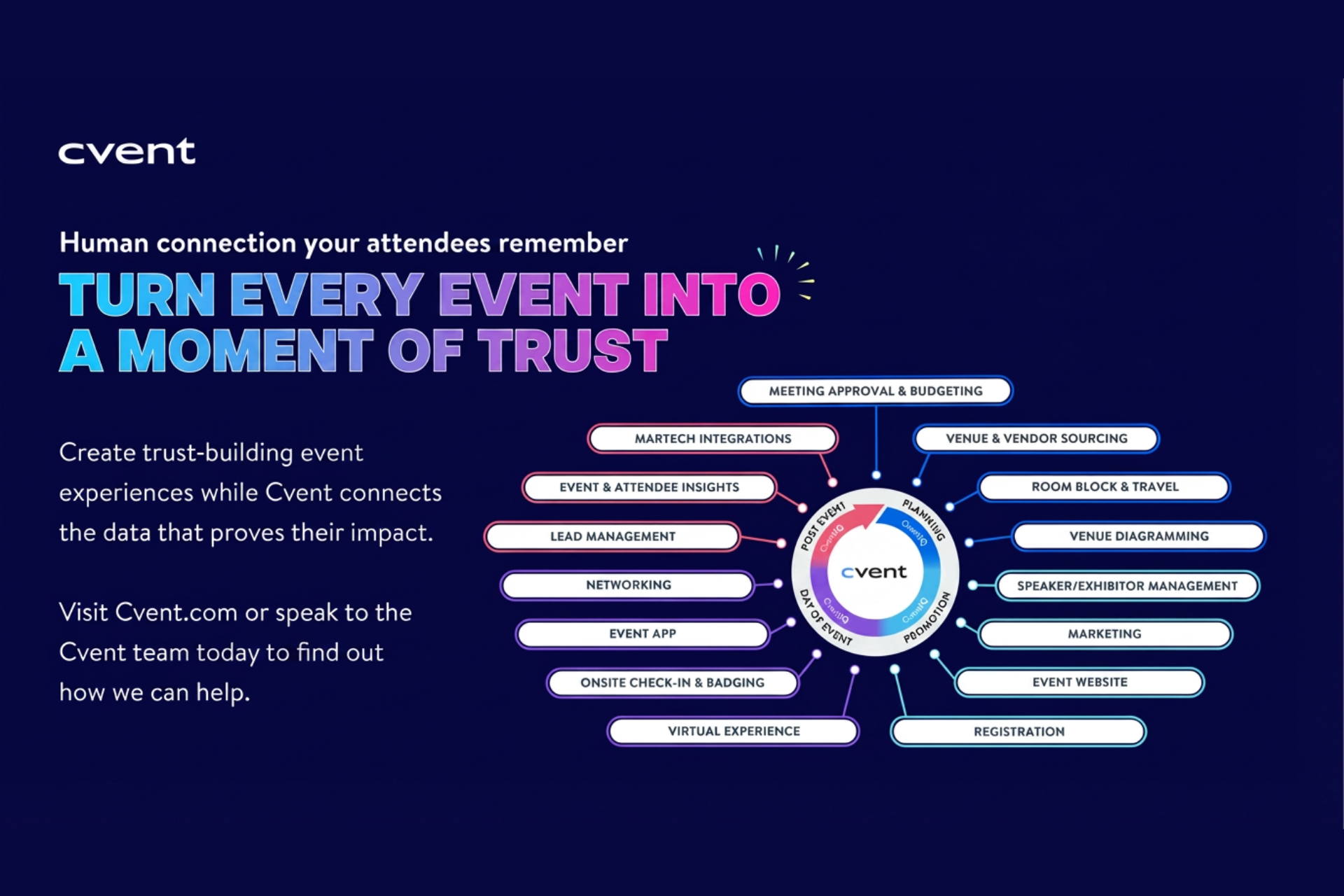
Our narrative is clear: in a low trust world, events are where trust is rebuilt – and Cvent is the system that makes those moments measurable, defensible, and worth the money. Events build human trust; measurement builds internal trust; Cvent connects the two by unifying data across the lifecycle so you can show exactly what your experiences deliver. For planners, marketers, and leaders who feel the trust gap widening across digital channels, that combination of human connection plus trustworthy data is what turns events from a risk into the safest bet in the marketing mix.
Learn more – Cvent.com