
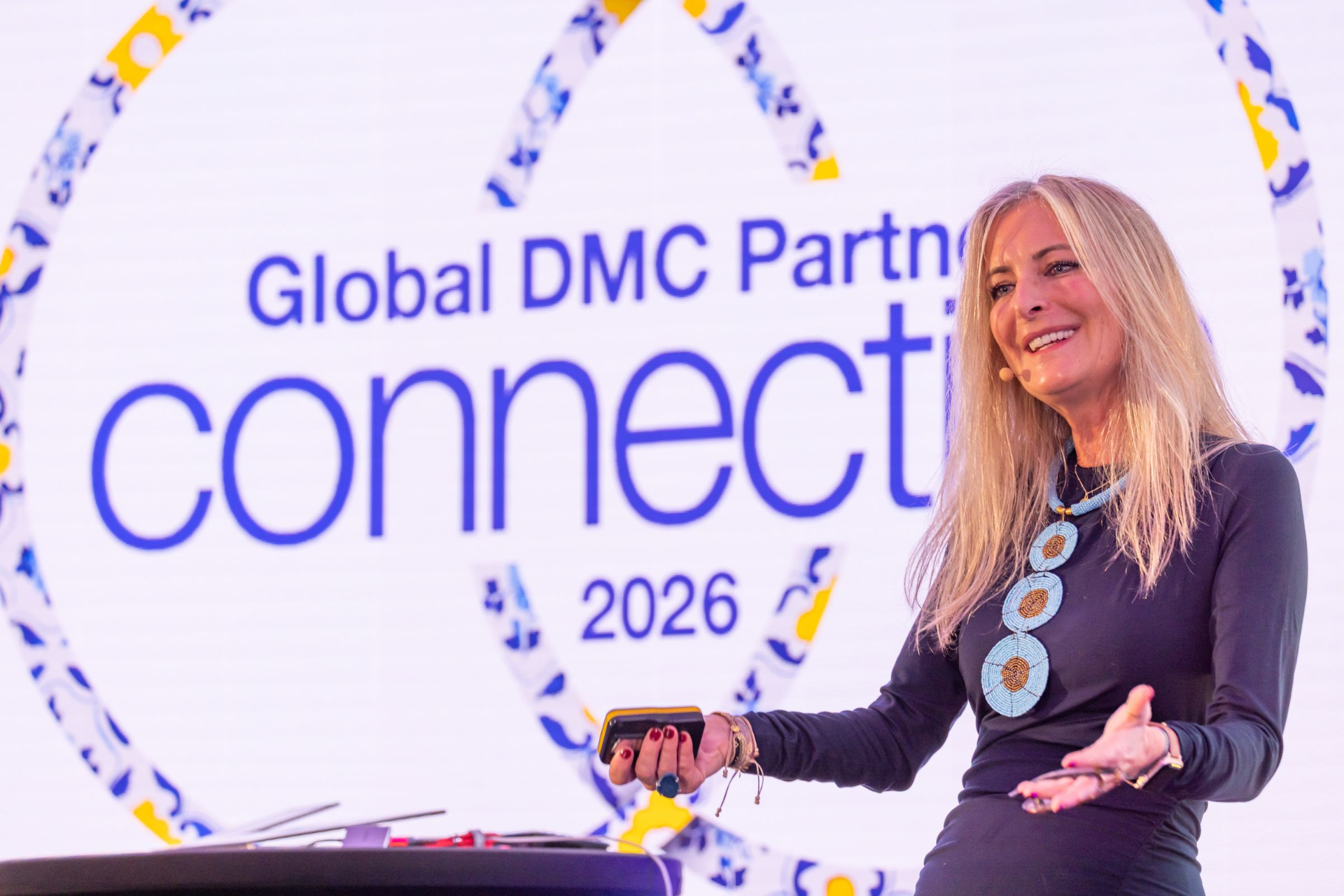
According to Catherine Chaulet, President and CEO of Global DMC Partners, the global MICE industry is living inside a paradox. The world has rarely felt more unstable, yet the business of bringing people together has never been more valuable. Speaking in her opening keynote at Global DMC Partners’ annual Connection event in Lisbon, held from January 8 to 11, 2026, she highlighted how inflation, geopolitics, AI disruption and visa delays are reshaping how events are delivered, whilst in-person connection is more critical than ever for organisations trying to grow, retain talent and stay competitive.
Her keynote, Future-Proofing Events: Key Global Trends & Industry Perspectives, delivered a clear message. MICE can no longer be treated as a discretionary spend to be trimmed when times get tough. In an increasingly fragmented world, meetings, incentives and conferences are becoming strategic tools that drive revenue and culture. Quoting Portuguese poet Fernando Pessoa, we were reminded that, “The value of things is not the time they last, but the intensity with which they occur,” a fitting way to describe the impact of live experiences.
A world of uncertainty, but a resilient MICE industry
For UK planners, the pressure is familiar. High inflation continues to squeeze real budgets, even as headline figures improve. Hotels, food and beverage and AV remain expensive, while geopolitical tensions and visa restrictions are complicating destination choice for international programmes. AI disruption and concerns about job losses are also adding further uncertainty.
Despite this, the wider data paints a more positive picture. Global travel and tourism now generates more than $2.1 trillion and supports more than 350 million jobs worldwide. Within that, the MICE sector was valued at around $1.2 trillion in 2025 and is forecast to grow at around 9 to 10 percent a year, with further growth projected by 2032, according to Fortune Business Insights and Grand View Research. That growth is already visible in buyer behaviour. GDP’s Industry Pulse Survey shows that half of organisations are holding MICE spend steady, while 30 percent are increasing budgets. The result is what Chaulet described as a paradox of uncertainty and optimism, where businesses remain cautious about the global outlook but continue to invest in live engagement.
Why in-person and incentives still win
The business case for face-to-face has rarely been clearer. One in-person meeting delivers the same impact as three virtual meetings, while more than 75 percent of customers still prefer or require live interaction. In the United States alone, meetings and events generate more than $280 billion in direct spending. Incentive travel remains a major driver. U.S. businesses spend around $176 billion a year on incentives, with incentive travel up 61 percent compared with 2019.
For every dollar invested, companies see an average return of $12.50 in revenue and $3.80 in profit, with overall programme ROI sitting at 112 percent. For UK agencies running sales-led or reward-driven programmes, those numbers help explain why incentives and conferences continue to win budget, even in tighter conditions. As Chaulet put it, “It is in these tough times that meeting face to face is essential.”
The luxury effect and an industry attracting investment
Premium and luxury travel continues to outperform the wider market. In what economists describe as a K-shaped economy, wealthier consumers keep spending while others pull back. Luxury travel is currently up 38 percent year-on-year, with premium hotels and air cabins holding strong. Incentives, executive meetings and premium conferences serve globally mobile, high-spend audiences, helping the sector remain resilient when mass travel slows.
Investment trends support that view. A wave of mergers and acquisitions across event technology, agencies, production, exhibitions and DMCs is gathering pace, involving groups such as Cvent, ITA Group, Freeman, MCI Group and American Express GBT. “When you have private equity investing in an industry, it usually means they have high hopes of high returns,” Chaulet said. “The MICE industry is very hot.”
What this means for 2026
Looking ahead, programmes are increasingly shaped by what Chaulet described as “FOMO meets slow-mo”. Clients still want to be in the room and part of the conversation, but they also want more space in their schedules. Over-packed agendas are giving way to more thoughtful, experience-led formats. Cost pressure remains a defining factor. More than 70 percent of planners are facing higher accommodation rates, while AV continues to be one of the hardest areas to control. Nearly half are exploring second-tier destinations to stretch budgets, while booking windows remain short and programmes are often confirmed much closer to delivery than they were pre-pandemic.
One of the strongest ideas in the keynote was a shift in how success is measured, summed up in a line often heard from finance leaders: “I don’t need to know how many people attended. I need to know what changed because they were in the room.” Shifting from reporting attendance and cost to reporting outcomes, sales pipeline and commercial impact is becoming essential if events are to be protected and grown.
Funding models are evolving alongside that shift. Sponsors increasingly expect tangible value rather than just visibility, while CVBs, DMOs and internal business units are becoming more involved as co-funders of programmes that support their goals. Sustainability and social responsibility are also moving beyond carbon metrics towards more meaningful engagement with local communities. Across all of these trends, the message from Lisbon was clear. In a world of volatility and rapid change, partnership, creativity and human connection remain the foundations of successful events. For UK planners looking ahead to 2026, the environment may be complex, but the case for MICE has rarely been stronger.