
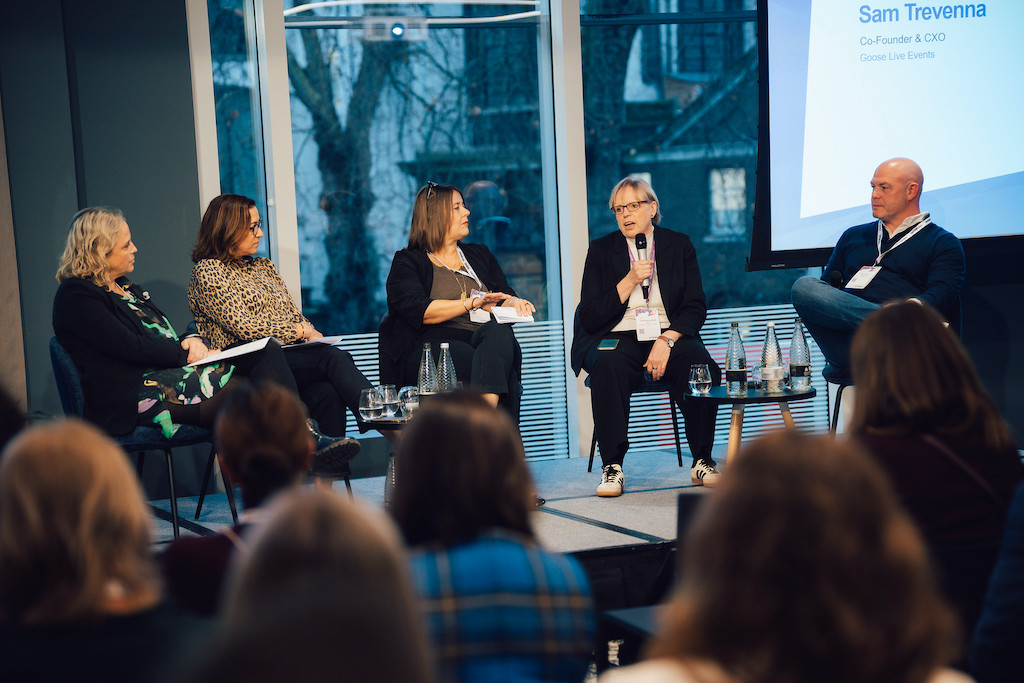
With mergers and acquisitions dominating industry headlines, the agency landscape feels more fluid than ever, resulting in much debate about which model is best – small or large, independent or collective.
At micebook EXPO, we gathered a panel of senior agency leaders to cut through the noise and get to the heart of what each approach means on the ground, for agencies of all sizes, for clients, and for the suppliers they partner with.
Representing a broad spectrum of models from small independents to global giants and hybrid group structures were representative from Goose Live Events, Ordinary Hero, American Express GBT Meetings & Events and asembl. Group.
The session explored a range of topics including agility, scale, talent, perception and power.
Different models, same reality
Despite wildly different operating structures, the panel quickly landed on a shared truth: no model has it easy.
For smaller independents, agility and senior-led delivery are clear advantages, but perception remains a constant hurdle. “As a small agency, we’re agile, dynamic, we can move fast,” said Goose CXO Sam Trevenna. “What makes it harder is perception. Sometimes people think that because we’re small, we’re not mighty, and that’s not true.”
Heather Robinson, MD of Ordinary Hero, echoed that sentiment, adding that independence allows her team to focus on delivery rather than growth for growth’s sake. “Our model allows us to stay agile for our clients and stay focused on what they need. But we also suffer from perception. People assume small equals cheap, and that just isn’t the case.”
At the other end of the spectrum, Catherine Southall, Head of Business Development, UK & Ireland, at Amex GBT Meetings & Events spoke about the advantages of scale including global reach, infrastructure and integrated technology, alongside the realities of operating within a large organisation.
“We can offer an end-to-end solution across travel, accommodation, meetings and events,” she explained. “But with that compliance and structure comes rigour, and that means it can take us a little longer to move and change.”
Meanwhile, Gavin Farley, CEO of asembl, is taking the group approach: independent specialist agencies operating within a shared ecosystem. “We can be 34 people in an agency, or 160 across the group,” he said. “We can scale up or down as needed. It’s about flexibility.”
While each approach has their pros and cons, fundamentally, everyone agreed they’re all focused on the same objective: bringing great people together to deliver great experiences for clients and their audiences.
Why consolidation keeps coming up
With “another day, another merger” becoming something of an industry refrain, the panel explored what’s really driving today’s consolidation.
For larger organisations, acquisitions form part of broader growth strategies. But Southall was clear that it’s never about buying for the sake of it. “It has to be the right fit,” she said. “You’re buying talent and relationships, and if you don’t handle integration well, you lose both.”
That risk resonated strongly with Trevenna, whose early career included working at an agency where an acquisition didn’t go to plan (although long term, it ended up being positive as it led to the creation of Goose).
“The worst thing that can happen is you win the deal but lose the people,” she said. “Then what have you actually bought?
Robinson highlighted succession planning and economic pressure as major factors, particularly for founders approaching exit. “There’s a whole generation of agency owners looking at what’s next. Commercial drivers and succession planning play a huge role, probably more so than client pressure.”
Farley added that acquisitions are rarely quick or straightforward. “It’s slow. It’s lethargic. Everyone thinks their business is worth a million pounds, but they’ve already taken all the value out over the years. What we’ve tried to build instead is a group model based on partnership, shared vision and pace,” he explained.
The human impact
As the conversation deepened, one theme kept resurfacing: people. Whether independent, global or group-based, talent and culture sit at the heart of every model.
Trevenna spoke about the breadth of experience smaller agencies can offer early careers. “When you’re young, you get to explore and get your hands dirty,” she said. “Everyone in our business plays a role. We also know our team personally, we can be flexible around life, family and neurodiversity.”
Southall shared her own initial hesitation about joining a global brand and how that perception quickly shifted. “Having always worked at smaller agencies, I did have concerns. But actually, within our Experience Studio we’re encouraged to be brave, to disrupt, to bring ideas. And if creativity isn’t your thing, there’s room to specialise in data, tech, strategy or whatever your strength is.”
For Farley, maintaining culture across multiple businesses is non-negotiable. “You’re nothing without your people. We meet quarterly as business owners, we’ve launched group-wide reward schemes, and we bring everyone together socially. But we also protect the individuality of each agency, and that’s why they joined the group in the first place.”
Robinson acknowledged that independence brings its own pressures, particularly around proving compliance and financial stability, but said it also creates deeper engagement. “Everyone contributes to the greater good. Our finance team is integrated with client delivery. Everyone has client interaction. That involvement makes people feel invested in the business,” she said.
Clients, suppliers, and the shifting balance of power
The final part of the discussion turned to what consolidation means beyond agencies themselves.
For clients, scale can unlock compliance, buying power and integrated systems. For independents, the appeal lies in focus, flexibility and senior attention.
For suppliers, the picture is more nuanced. “Yes, spend is going up,” Farley noted. “That can mean better rates and more opportunity. But honestly? Don’t get distracted by what everyone else is doing. Be really good at what you do and build strong relationships.”
Southall agreed, stressing that large agencies still rely entirely on their supply partners. “You can’t run events without suppliers. Partnerships matter, regardless of size.”
From the independent side, Trevenna and Robinson both acknowledged frustrations around losing dedicated account management with some global suppliers but emphasised the role agencies often play as mediators between corporate procurement and supplier realities.
“It’s that impossible triangle. Clients want the best price, suppliers want quick contracts, and procurement has its own rules. We end up being the diplomat in the middle,” said Trevenna.
Robinson added that independence allows her team to stay focused on delivery rather than internal integration or growth targets. “Our attention is always on the work. That’s a real positive for clients because they don’t feel we’re distracted.”
Final thought
Consolidation may be reshaping the agency landscape, but it hasn’t changed the fundamentals. This is still a people business – culture still matters and relationships still drive success.
Whether independent, global or somewhere in between, the agencies that thrive will be the ones that stay clear on who they are, what they offer, and why clients and partners should choose them.