
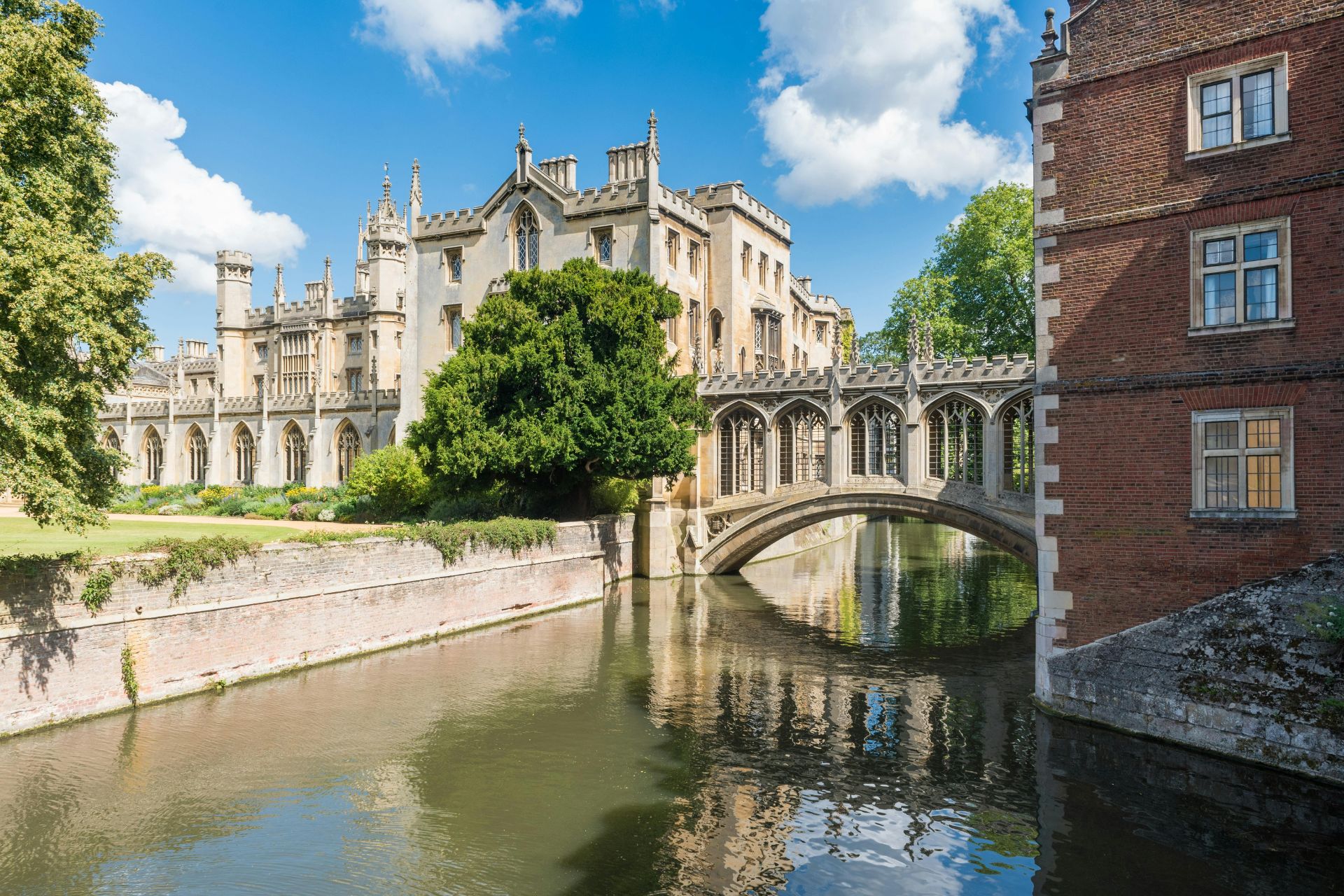
Cambridge is one of those cities that manages to be internationally famous and yet incredibly compact at the same time. Eight hundred years of university history sit inside a walkable centre, where cobbled lanes open onto college courtyards, the River Cam winds past willow trees and stone bridges, and the skyline is still dominated by spires rather than glass towers. You don’t have to try hard to make an event feel special when the backdrop’s doing half the work for you.
It’s also easy to overlook when the instinct is to look abroad for a location with real character. Cambridge sits under an hour from London, and the combination of that history, a well established cluster of venues, and straightforward access makes it worth a proper look for conferences, incentive trips and client events alike.
Getting there: easier than you’d think
Cambridge sits under 50 miles from London, and direct trains from King’s Cross get you there in as little as 49 minutes, with services running roughly every half hour throughout the day. No security queues, no baggage limits, no early check-in cut-offs. For delegates travelling from London or connecting through a London airport, that’s a straightforward add-on rather than a full travel day. It also means Cambridge works well as a day-trip destination for events that don’t require overnight stays.
Where to stay and meet
The University Arms Hotel sits right on Parker’s Piece, a short walk from the colleges. It’s Cambridge’s oldest hotel, dating back to 1834, and its recent renovation by architect John Simpson and designer Martin Brudnizki leans hard into the city’s academic character. We’re talking tie-patterned carpets, oak panelling, and a library that feels pulled straight from one of the colleges. Details throughout nod to Cambridge’s history and alumni, so there’s always something to notice in the artwork and décor.
The 189 rooms and suites carry that same feel through, with everything guests need close at hand. Each of the twelve suites is named after a Cambridge-affiliated alumnus; I stayed in the Hawking Suite, overlooking Parker’s Piece. For planning purposes, the range and volume of rooms available is more than enough to house a decent-sized delegate group without anyone feeling like an afterthought.
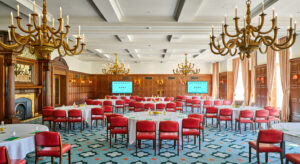
On the events side, the standout space is the Ballroom, a striking room with floor to ceiling stained-glass windows depicting the coats of arms of Cambridge colleges. It’s suited to everything from conferences and gala dinners to award ceremonies and product launches, and comfortably accommodates a sizeable group either standing or seated. A solid oak partition allows it to split into two smaller rooms, giving the flexibility to scale down for a more intimate gathering. A third room, the Newton, rounds things out for smaller meetings. Between them, the spaces flex from a boardroom session up to a full conference without ever leaving the building.
For events larger than the hotel alone can house, the Hilton Cambridge City Centre is the largest hotel actually in the city centre and can cover overflow rooms, while the Cambridge Belfry, a lakeside hotel just outside the city, has its own meeting space for up to 250 if you need a second venue option nearby.
What to do: colleges, punting, and a legend or two
Part of Cambridge’s charm is that it’s very walkable, and it helps enormously to have someone show delegates around who actually knows the place. My guide, Beverly van Buuren, tailored the whole walking tour to my interests, weaving in the bits a standard itinerary would miss: which courtyards you’re actually allowed to wander into, which chapels are worth seeing, and the stories behind hidden corners you’d otherwise just walk past, such as the legend of Cambridge’s “Night Climbers,” students who have supposedly been scaling the colleges’ spires, chimneys and rooftops after dark for over a century. Whether this tradition is still going on today depends who you ask, but hearing it while standing beneath the very spot in question is the kind of local knowledge that turns a walking tour into something closer to stepping inside the destination’s history.
And of course, did you even visit Cambridge if you didn’t go punting? A private punt is the only way to see the college “Backs” without paying for entry, and it’s a particularly lovely way to spend an hour, especially on a hot day. Groups can arrange drinks or a picnic on board, and the punter typically doubles as a storyteller, pointing out details along the river you’d otherwise miss entirely. It’s also possible to have a go yourself, although as my guide was quick to point out, not always advisable.
Venue spotlight: the colleges
Walking through centuries of history like this, it’s easy to picture hosting an event somewhere in it, and several of the colleges can make that possible. Trinity Hall offers riverside grounds and historic rooms for conferences and dinners, with exclusive use of Latham Lawn and the River Terrace for drinks receptions. St John’s has 18 acres of grounds overlooking the River Cam, with spaces for conferences, evening receptions and private dinners. King’s College offers its grounds and halls for residential conferences, corporate dinners and receptions, while Corpus Christi has spaces across its Old Court, New Court and a lecture theatre for everything from business meetings to formal dinners.
Availability is worth checking early, since Cambridge is a working university. Full Term runs across three eight-week teaching blocks between October and June, when the colleges are busiest and space can be harder to secure. Summer holidays run from late June to the end of September and are generally the quietest stretch to book, although July also brings graduation ceremonies, so it’s worth confirming exact dates with each college.
If you’re planning something and don’t fancy approaching colleges one by one, it’s worth knowing about Meet Cambridge, the official, free venue-finding service owned by the Cambridge colleges themselves, which matches events with spaces across the university and its colleges. A useful shortcut if a college lawn or hall is on your event wish list.
Where to eat and drink
Cambridge is not short of options when it comes to food and drink. It’s not just a city of libraries and lecture halls, there’s a proper food scene to easily build a delegate itinerary around.
Start with Fitzbillies, a Cambridge institution since 1920 and still famous for its Chelsea buns, baked by hand to the original recipe and sold by the hundreds of thousands every year. It’s the kind of local landmark worth pointing delegates toward for a mid-tour treat, or even sourcing as a welcome gift or conference table snack.
For sit-down dining, Parker’s Tavern, the restaurant inside the University Arms, offers spectacular views and and an even more spectacular menu, which leans into East Anglian produce with a modern British brasserie style. The room itself is designed to echo a college dining hall, with stained glass and leather bench seating, and it runs breakfast through to dinner plus afternoon tea. Beyond the main dining room, it also handles private dining and exclusive use hire for delegate groups who want something more intimate than the Ballroom.
For a pint with a serious side of history, and a memorable stop on a delegate itinerary, there’s The Eagle on Bene’t Street. It’s one of Cambridge’s oldest pubs, dating back to 1667, and its back room, known as the RAF Bar, has a ceiling covered in names, squadron numbers and doodles burned or scrawled on by RAF and American airmen during the Second World War, using candles, lighters and even lipstick. The tradition is said to have started when an RAF flight sergeant climbed onto a table one evening and burned his squadron number into the ceiling; the graffiti was later rediscovered and carefully preserved in the 1990s, and it’s still there to see today. It’s also where Francis Crick and James Watson are said to have announced they’d “discovered the secret of life” in 1953, the structure of DNA. There’s a plaque on the wall, and obviously, a beer named after it.
A unique event venue: IWM Duxford
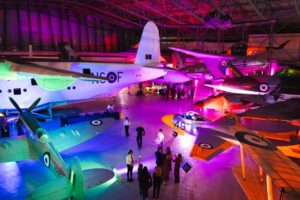
If you’ve got a group looking for something a little different, IWM Duxford is well worth the trip out. It works equally well as a fun day out for a delegate group between sessions, or as a unique setting for a gala dinner or standalone event. The venue offering is just as flexible as the setting suggests. There’s the Concorde Suite for larger conferences, the Airside Suite overlooking the museum’s active runway for receptions and banqueting, and a purpose-built conference centre within the AirSpace hangar with a mix of smaller meeting rooms and a tiered auditorium for presentations. For something bigger still, the wider site can host large-scale events including gala dinners among the aircraft themselves, which is not something you’ll find on most delegate itineraries.
The takeaway
You don’t always need to look abroad to find a location with excellent event credentials and history to boot. Cambridge offers stunning architecture, a river, excellent catering options and a set of impressive venues, all within an hour of London. Next time a brief calls for somewhere with a story to tell, it might be worth checking the train times first.