
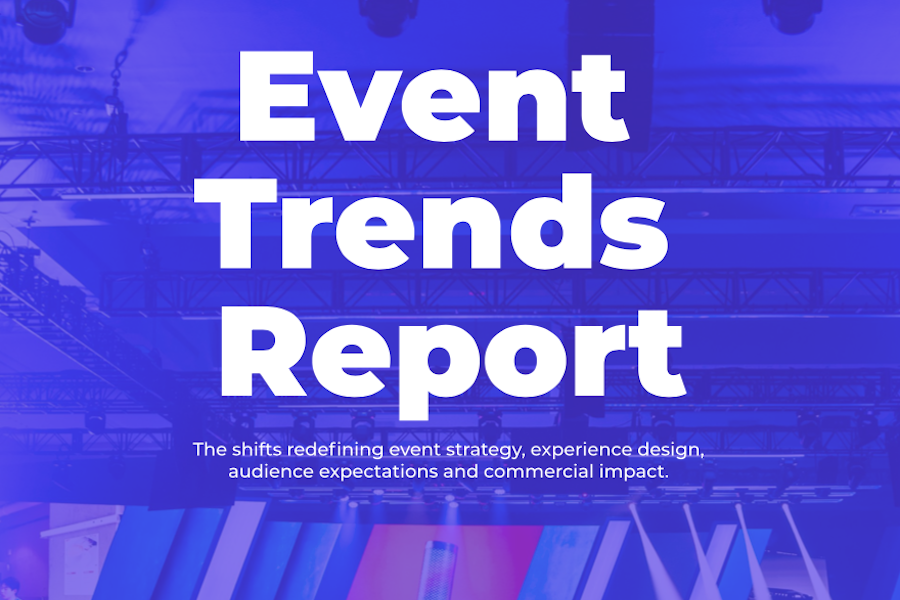
Event teams are being challenged to rethink how they design, deliver and measure experiences, according to a new report launched today by global experience agency emc3 at Cannes Lions International Festival of Creativity.
The emc3 Collective Event Trends Report brings together industry data and insights from leaders at organisations including Meta, Mastercard, Pinterest, Lenovo, Stripe, Dolby, Nokia and Figma to explore the forces shaping event strategy in 2026.
The report argues that 2026 will be a year of “sharper judgement” for event teams, with success increasingly determined by relevance, intentional design and business impact rather than scale alone. As budgets remain under pressure and audiences become more selective, event leaders are being forced to make more deliberate decisions about where they invest and how they demonstrate value.
At the heart of the report are five key shifts that emc3 believes are redefining event strategy in 2026.
1. Fewer moments, stronger meaning
According to the report, the industry is moving away from excess and towards more intentional event design.
Teams are being more deliberate around where they spend, what they produce and how they justify it. 95% of event professionals say experiential learning elements are important, while planners continue to prioritise depth over breadth through more focused, higher-value formats.
As Jon Wolff, senior global events manager at Lenovo, notes: “There’s pressure to chase every format, trend and moment, when the real opportunity lies in saying ‘no’ more often.”
2. B2B becomes B2Human
The report suggests business audiences bring the same behavioural expectations they have elsewhere: speed, relevance, intuition and emotion.
Dry, over-engineered experiences are becoming harder to justify when audiences expect the same fluency they get from consumer platforms. Leadership teams are increasingly evaluating events against pipeline, deal velocity and retention rather than attendance alone, pulling live experiences closer to the core go-to-market engine.
3. Selective audiences, higher stakes
While demand for live events remains strong, attendance is becoming more conditional. The report cites research showing that 56% of attendees expect to attend more events in 2026 than they did in 2025, while 97.4% rate in-person events as important to their plans.
The appetite exists, but it is no longer automatic. Audiences may be planning to attend more, while also making sharper decisions about which events justify their time, travel and attention. As a result, every event must deliver a more obvious value exchange.
4. Content becomes the experience
Content is no longer confined to the stage, according to the report. It has now become narrative backbone for the whole event. Content created for or presented on site remains the leading investment area, while 78% rate content quality as very important to event success.
As Lorena Correa, Nokia creative director, explains: “Defining a single narrative early is often underestimated. In complex environments, teams tend to want to promote their own stories, timelines and priorities. Without strong alignment, this leads to a fragmented experience.”
5. AI moves past hype to utility
The report argues that AI is moving from novelty to a core workflow tool, but maturity is still uneven. 95% expect their organisation’s use of AI in events to increase, including 35% who expect significant increases. The industry is still learning where it genuinely adds value.
Beyond the five shifts, the report highlights several wider trends shaping the industry.
Budget constraints remain the biggest challenge facing event professionals, cited by 61.9% of respondents, while teams are also grappling with attendee engagement, stakeholder management and technology integration. At the same time, 40% expect budgets to grow, 40% expect them to remain flat and 20% expect them to decline.
The report also suggests sustainability is becoming increasingly embedded within procurement and event design. It notes that 62% of event RFPs now include sustainability requirements, while accessibility and inclusion are becoming key measures of event quality and credibility.
“Sustainability increasingly plays a tangible role in procurement and commercial success. Credentials demonstrate governance, transparency, and measurable impact, which reduces perceived risk for clients,” says Lee-Anne Caldwell, group managing director at emc3 Collective.
Meanwhile, experience design continues to evolve beyond the headline moments. The report argues that arrival experiences, networking opportunities, transitions between sessions and the overall attendee journey are becoming just as important as keynote content and stage production.
As Ariel Quaglia, experiential marketing lead at Pinterest, puts it: “In 2026 the most successful activations will be those that deliberately slow things down, build for community, and restore connection instead of competing for attention.”
The report concludes that there is an opportunity to make events clearer, more useful and more defensible. The events that stand out will be the ones that respect the audience’s time, make the business case easier to understand and create impact that lasts beyond the live moment.
Check out the full report here – https://emc3.com/resources/2026-event-trends-report/