
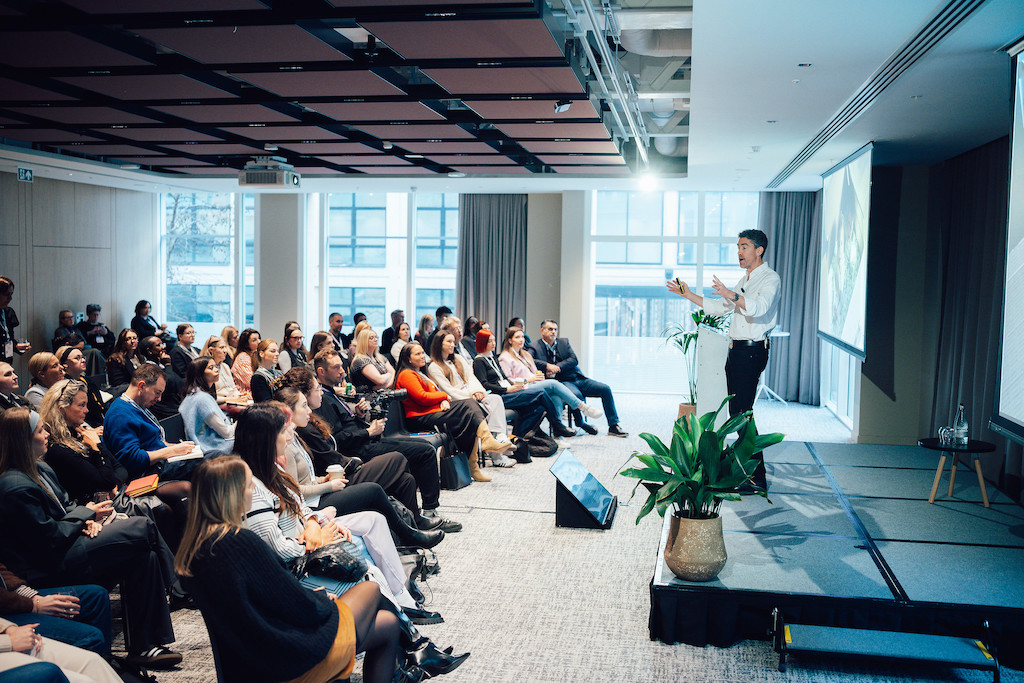
In partnership with Speakers Corner, former Warner Bros creative lead Jason Bevan delivered a high-energy keynote at micebook EXPO that was packed with film stories, practical takeaways and a clear challenge to event professionals: stop staying on the train tracks.
Drawing on his career as former Head of Creative Development and VP Marketing EMEA at Warner Bros. Studios, Bevan shared lessons from working across franchises including Harry Potter, The Dark Knight trilogy, Joker and The Hobbit, alongside directors and creatives such as Steven Spielberg, Christopher Nolan and Peter Jackson.
But this was not a nostalgia tour of Hollywood moments. Bevan was clear from the outset that the goal was practical. “I really want you to enjoy this session,” he told the room. “But what’s important is that you can actually go back to your desks, to your offices, your working environments, with some practical things that you can do differently.”
Everyone can be creative
Bevan began by challenging a common assumption: that creativity belongs to a select few. “I really passionately believe every single one of you can do it,” he said.
The problem, he explained, is not capability but conditioning. Children think expansively. Ideas go straight from head to mouth. Adults, on the other hand, filter everything.
“We think of something, then we go, well hang on. How does that make me look? There’s a client there, there’s my boss over there. And quite often that crazy idea gets put to the back of our heads.”
For Bevan, that instinct to self-edit is one of the biggest barriers to breakthrough thinking in agencies and event teams.
Rule breaking, not window dressing
One of Bevan’s core principles was what he called rule breaking. Not changing colours or venues. Not tweaking formats. But questioning the conventions that quietly govern how events are built.
“The default status for many of us is that we’re all trained on tracks,” he said. “The client brief comes in, we look at objectives, we look at budget, and we come up with a nice solution.”
The danger is repetition. “When something works, and our bosses like it and our clients like it, what do we do? We repeat it.”
True creativity, he argued, comes from identifying what is genuinely fixed and what is simply tradition. “Look at what things are rules, and the things that aren’t rules, they’re conventions and traditions. Things that we follow because it’s easy.”
He compared this to how companies like Netflix and Apple rewrote the rules of their industries, not by adding polish but by rethinking the fundamentals. Even generative AI, he said, risks being treated as surface-level enhancement.
“Train track thinking is using generative AI to develop nice pictures and reorder language. Getting off the train tracks means integrating it into the fabric of what you do and creating something that wouldn’t have been possible before.”
Hollywood has constraints too
Bevan pushed back on the idea that film studios operate in a fantasy world of unlimited budgets. He said filmmakers face the same pressures event professionals do – logistics, deadlines, regulations and financial scrutiny.
“They have incredibly complicated financial structures. Huge timelines. Serious implications if they miss deadlines. Resonating with you as well.”
Creativity, he said, does not come from unlimited freedom. It comes from navigating constraints with courage.
He shared examples from films like Tenet, where a real Boeing 747 was crashed into a hangar, and Inception, where Christopher Nolan built a rotating hotel corridor rather than relying on visual effects.
These decisions were expensive, risky and controversial. But they created moments audiences had never seen before.
Build ideas with “yes, and”
Another powerful takeaway was Bevan’s approach to brainstorming. He urged teams to replace instinctive rejection with collaborative building.
“When someone comes up with an idea and you go, well that’s not going to work, you squash it straight away.”
Instead, he advocates a simple rule: yes, and. Ideas, he explained, are fragile when they first emerge. They need space to grow.
“As an idea circulates in a room, it gets stronger. And something important happens. It stops becoming my idea, and it becomes our idea.” That shared ownership dramatically increases buy-in and improves outcomes. “It’s totally transformative.”
Creativity needs the right environment
Bevan also spoke about the emotional conditions required for creativity. On the Harry Potter sets, many of the lead roles were played by children. To support them, producers deliberately created warm, playful environments.
“They knew they had to make the environment fun and friendly and warm. And that’s exactly what they did.”
There is science behind this, Bevan explained. When people feel happy and safe, dopamine and oxytocin support cognitive performance and connection. Stress shuts creativity down.
“If you’ve ever tried to be creative when you’re under pressure, it’s virtually impossible.” His advice for agencies was simple: get out of the office, change environments, walk, move, create spaces that feel different. “When was the last time you came up with a good idea sitting at your desk?”
Get comfortable being uncomfortable
One of the strongest messages of the session was about creative courage. Bevan encouraged delegates to embrace discomfort as a sign they had left familiar territory.
“When you feel that gravity in your stomach, that’s a tangible sign that you’ve left your train tracks.” He cited examples including Joker and Barbie, campaigns that broke genre expectations and carried enormous reputational risk.
“Get comfortable being uncomfortable every now and again,” he said. “A client is not always going to love every bold idea. But good clients appreciate being stretched.”
Failure, he added, is part of the process. “We have to celebrate failure. Try new things. Test them out.”
Shake up who’s in the room
Finally, Bevan urged agencies to diversify their creative inputs. If everyone in a brainstorm looks and sounds the same, the ideas will too.
“Bring people in who have no connection to events whatsoever. They don’t know your rules and conventions.”
At Warner Bros, he built intern programmes specifically to inject younger voices into campaigns aimed at younger audiences. “They’ll come up with some crazy stuff that’s totally unworkable. But they’ll also refresh your thinking.”
The takeaway for micebook readers
Bevan’s keynote was a call to move beyond safe solutions and surface-level creativity.
Break conventions.
Create positive environments.
Build ideas together.
Invite discomfort.
Change who’s in the room.
Because blockbuster experiences, whether on screen or on stage, do not come from playing it safe. They come from courage.